First time hiring a foreigner as an opportunity for growth
The Arrival of the Black Ships Teaches Us the Opportunity of "Change
The "arrival of the Black Ships" in Japan in 1853, when a fleet of four ships, including two steamships led by American Commodore Matthew Perry, appeared in Japan, sent shock waves through Japan at that time. The black smoke-spewing steamships were feared as an unknown threat, but as a result, Japan opened its borders and began its path to modernization. This event symbolizes the opening of new possibilities by embracing change without fear.

Updating "Fear of the Unknown" to "Driving Force for Growth
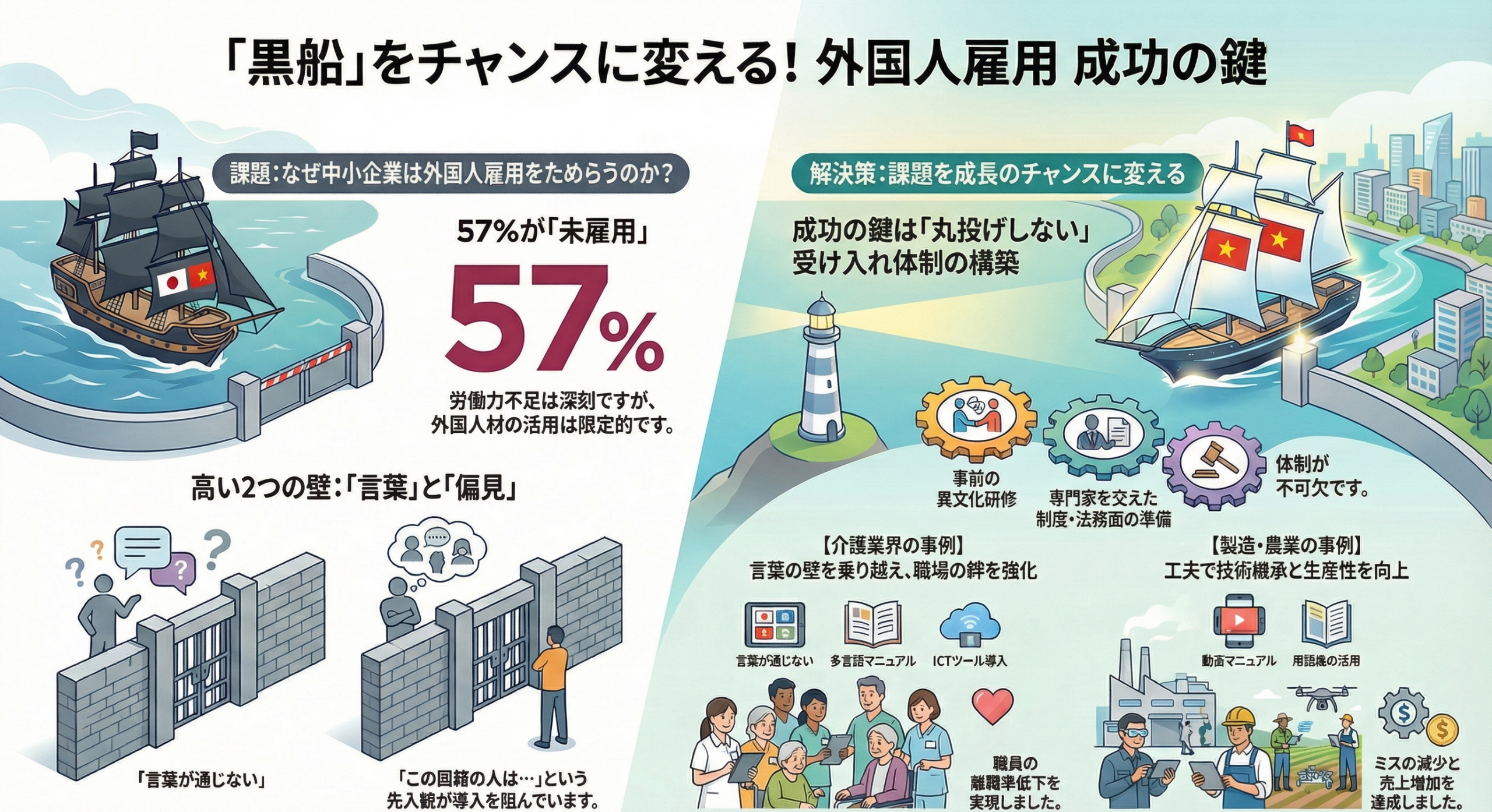
For small and medium-sized enterprises in modern Japan, hiring foreign employees for the first time may be just like the appearance of this "black ship. As labor shortages worsen, the use of foreign human resources has become an unavoidable option; by the end of 2023, the number of foreign residents in Japan will have reached approximately 3.41 million, a record high. However, according to the 2025 survey by Teikoku Databank, only 24.71 TP3T of all companies employ foreign nationals, and the situation remains limited, especially among small and medium-sized companies, where the percentage of unemployed workers is as high as 571 TP3T. Unfortunately, prejudice based on nationality remains in some companies. In some cases, companies are selecting personnel based on preconceived notions such as "people of this nationality are not trustworthy. This not only causes companies to miss out on talented people with diverse perspectives and skills, but also hinders the growth of the company as a whole. In fact, diversity is a source of innovation. The addition of employees with different cultural backgrounds can generate new ideas and enhance a company's ability to respond to the global marketplace. The White Paper on Small and Medium Enterprises (2025 edition) also introduces examples of how small and medium-sized enterprises in regional areas have achieved growth under a declining population by proactively utilizing foreign human resources.
Lively and bonding atmosphere was created onsite, transcending language barriers.
We also often hear concerns about avoiding this type of work because of language barriers, but using actual examples from other companies as a criterion for judgment will help dispel such concerns. For example, BENESSE STYLE CARE CORPORATION, which operates nursing care facilities, has accepted 24 foreign caregivers through the specified skills system. In order to overcome the language barrier, the company provides Japanese-language education in advance and thorough on-the-job training (OJT) on site, and has also introduced multilingual manuals and ICT tools. As a result, foreign employees are now able to smoothly perform physical care and recreational activities, and communication with the residents has been revitalized. In one case, a resident taught Japanese to a foreign staff member, and the atmosphere of the entire facility became brighter. In addition, the enthusiasm of the foreign staff has provided a positive stimulus to the Japanese staff, leading to a decrease in the overall retirement rate.
The power of "ingenuity" that has realized technological succession and productivity improvement
On the other hand, in the manufacturing industry, FURUYA INDUSTRY CO., LTD. which deals with plastic products has been successfully accepting Vietnamese personnel since 2003. The company invited mold engineers from Vietnam, which was in short supply in Japan, and provided Japanese language training and cultural exchange programs as language support. Even in operations with many technical terms, the use of video manuals and pictograms to provide instructions has reduced errors and improved productivity. Today, foreign personnel play an important role in passing on skills, contributing to the expansion of the ratio of overseas sales.
Medium- to long-term growth strategy envisioned by "Stable Labor Force
In addition, Takagi Farm, a limited company in the agricultural field, employs trainees who have completed technical internship training in specified skills. While language nuances are important in the detailed work of crop care, the company responds by providing practical on-site guidance and a glossary of terms, based on daily conversational level Japanese. With a stable labor force, medium- to long-term planning has become possible, and the company has succeeded in improving crop quality and shipping efficiency. Work during the peak season has become smoother, leading to increased sales.
New foundation to support long-term retention
As these successful examples show, with appropriate language support (training, multilingualization of manuals, introduction of tools) and advance preparation, language barriers can be sufficiently overcome. In fact, a multilingual environment can be expected to improve overall communication skills within the company, and the 2025 revision of the specified skills system will make the system even easier to use, with the target fields being expanded to 16. This will promote the long-term retention of foreign human resources and strengthen the foundation to support stable corporate growth.
The key to success is not to "throw it all away" but to build a sincere acceptance system.
Even more problematic is the phenomenon of neglecting the development of an acceptance system. If you take the easy way out when hiring for the first time and say, "Let's just hire them for now," you are likely to run into trouble due to communication barriers and cultural differences. For example, if language barriers are ignored, work instructions will not be conveyed correctly and productivity will suffer. Failure to comply with visa and labor laws can also lead to legal risks. To avoid these challenges, advance preparation is essential. First, encourage cross-cultural understanding among your employees by providing in-house training. Introducing basic communication tools in English and other languages can also be effective. It is also important to establish a legal and institutional foundation, such as consulting with experts to coordinate work visa procedures and benefits. By establishing such a system, foreign employees can play an active role with peace of mind, and the motivation of the entire company will increase. In fact, 14.31 TP3T companies intend to expand their employment of foreign nationals, and the number of successful cases is on the rise.
Farewell to prejudice. Let's work together with a diverse group of people to bring about the "2025 Restoration.
The arrival of the Black Ships forced Japan to change, but it also led to the Meiji Restoration. Similarly, a proactive attitude of welcoming the "black ships" of foreign employment without fear is the key to a brighter future for small and medium-sized businesses and a dramatic increase in their competitiveness. If we put aside our prejudices and establish a solid system, it will turn into an overwhelming opportunity, not a threat. Now is the time for your company to take a bold step forward and usher in a new era of growth with a diverse workforce!
Importance of cross-cultural training
Cross-cultural training is a training program designed to facilitate communication and deepen mutual understanding between people from different cultural backgrounds. Participants learn mainly about differences in values, communication styles, and business customs, and develop practical skills through role-playing and case studies. This training is indispensable in today's globalized society.
1. dealing with the progress of globalization and multicultural environment
In today's business world, opportunities for diverse cultures to intermingle with each other are rapidly increasing due to the expansion of overseas operations and the increase in foreign personnel. For example, as companies expand their overseas locations, immigration increases, and online interaction through IT tools becomes more commonplace, a lack of cross-cultural understanding can lead to misunderstandings and friction, resulting in project delays and worsening relationships. Cross-cultural training prevents these risks and fosters respect for different values (e.g., individualism vs. collectivism, high context culture vs. low context culture). This will help build trust and enhance competitiveness in international business. This is especially important for Japanese companies to improve the retention rate of foreign employees and to respond to inbound demand. Through training, it is expected to enhance teamwork and improve productivity.
2. prevention of misunderstandings and effective communication
Between different cultures, misunderstandings can easily occur due to differences in cultural nuances even when the language is understood. For example, the concept of "overtime" or the use of Japanese English may not be correctly conveyed to the other party. In the training, participants learn polite communication with an emphasis on feedback, and acquire the skills to eliminate stereotypes and accurately understand the other person's culture. This improves overall competence, including non-verbal communication (gestures, facial expressions), and creates synergy in collaboration. As a result, you can prevent the loss of business opportunities and achieve better-than-expected results.
3. personal growth and strengthening of the organization as a whole
Cross-cultural training provides an opportunity to not only learn about the other's culture, but also to objectify one's own culture and identity. This allows participants to develop multiple perspectives and become aware of unconscious biases. At the corporate level, it promotes innovation, improves employee satisfaction, and supports the development and retention of global human resources. Particularly in a rapidly changing marketplace, cross-cultural understanding provides the foundation for shaping the next generation of leadership and enables sustainable organizational growth.
 日本語
日本語  English
  简体中文
简体中文  Français
  Español
  한국어
한국어  Tiếng Việt