Unreachable Spring Footsteps: "Cliffhangers" for International Students on the Verge of Graduating from Japanese Language School
Every year around this time, there is a corner of the Japanese language school classroom where a heavy atmosphere prevails. Attendance rates are excellent, and Japanese language skills are good enough for daily conversation. Yet, the graduation ceremony is approaching, and the students are still unable to obtain the two words, "job offer.
Many of them came to Japan after graduating from college or interrupting their careers in their home countries to give their lives a shot. However, the reality is that the barriers to finding employment in Japan are higher and thicker than one might imagine.
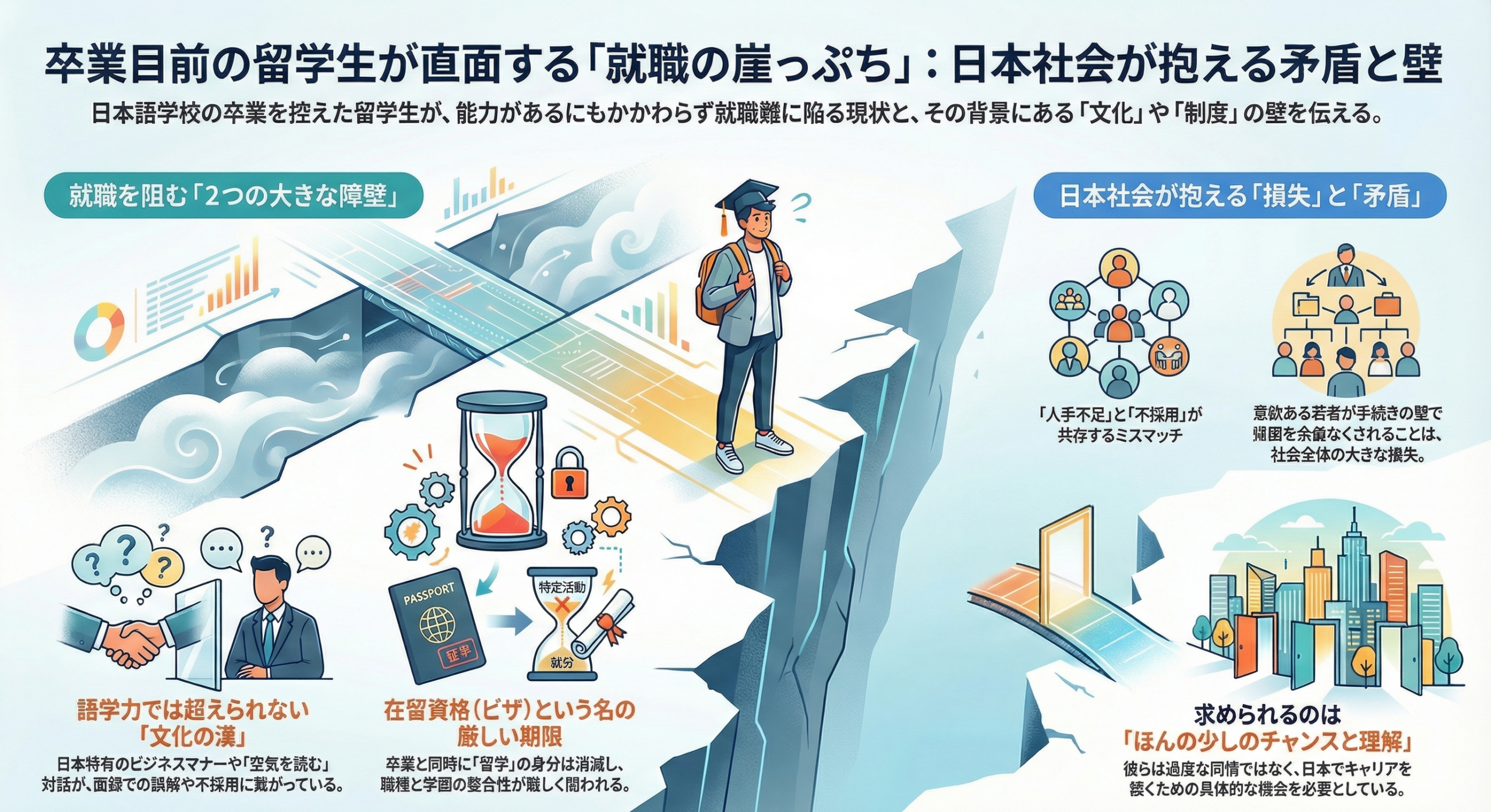
- The "N2" barrier and the "cultural divide" that cannot be measured by language proficiency alone
The Japanese Language Proficiency Test (JLPT) N2 is considered the minimum requirement for employment. Even if you study hard and pass the test, you will be repelled by unspoken rules that are not found in textbooks, such as "business manners unique to Japan" and "air-reading dialogue" at the interview. What are your strengths? the difference between cultures where modesty is considered a virtue and those where assertiveness is considered a good thing can be misinterpreted by the interviewer as "passive" or "overconfident. Without being able to correct the discrepancy, only rejection letters accumulate in the mailbox. - Specified Skills" or "Skills, People, and Country"? Screening in the Name of Visa
The most critical issue for international students is the expiration date of their visa status. Upon graduation, your status as a student will expire.
Technical/Humanities/International Services (Technical/Humanities/International): University degree and consistency with the job description are strictly required.
Specific Skills": Although the doors have opened in areas where there is a labor shortage, many students struggle with the timing of the examinations and the matching of job types.
Are you going to find a job?" is an expectant message from his family, and he spends the night without being able to read it. That loneliness is too harsh for a young person trying to stand on his own in a foreign land.
- Contradiction between society's "labor shortage" and their "non-adoption".
Japanese society is suffering from a serious labor shortage. On the other hand, young people who are right in front of us, who love Japan and want to work in Japan, are forced to return to their home countries before they are counted as "manpower" due to barriers of procedures and mismatches. This is not only a tragedy for the young people themselves, but also a great loss for the receiving side, the Japanese society.
Time is running out.
Less than two months to go until the graduation ceremony. They are cutting back on part-time jobs and using the money to pay for transportation to job hunting. What they are looking for is not excessive sympathy. What they are looking for is just a little chance and understanding to hold on to their dream of working in Japan as a real "career.
Will their efforts be rewarded and will they be able to look up at the cherry blossoms in their new suits this spring? Or will they have to cross the ocean again halfway?
 日本語
日本語  English
  简体中文
简体中文  Français
  Español
  한국어
한국어  Tiếng Việt