
What is the definition of "business sustainability" that the Immigration Bureau will focus on in the latest "Management and Administration" visa examination in 2026?
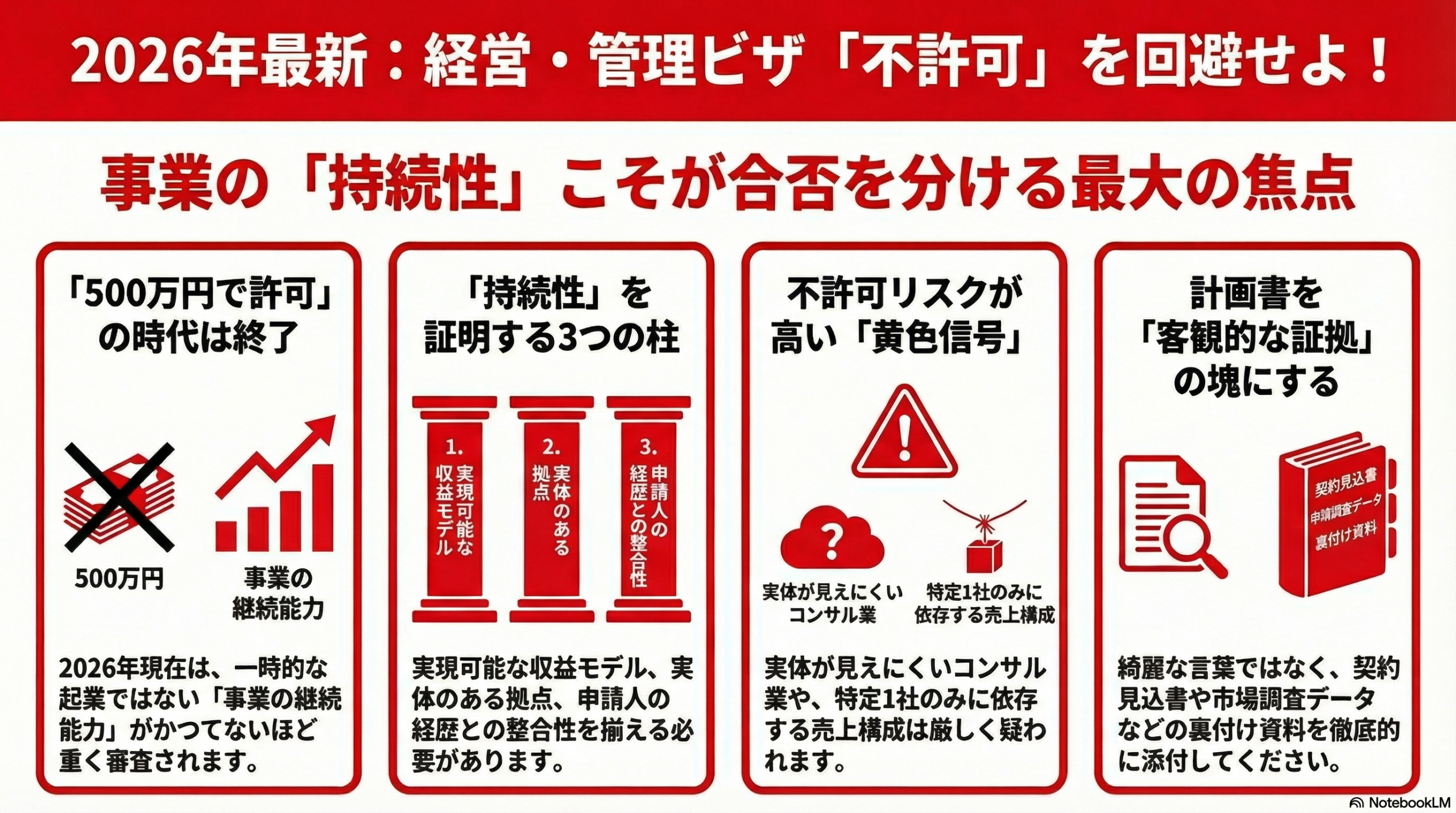
The days of "all you need is 5 million yen to get a visa" are completely over: since the October 2025 revision, the term "business sustainability" has been treated more seriously than ever before in the immigration examination process. In this article, we will thoroughly explain the true definition of "sustainability" and what the examiners are looking for in order to avoid denial of a visa, based on the latest examination trends in 2026.
1. why is "sustainability" now being severely questioned?
- Background: Rampant fraudulent acquisitions by paper companies.
- Aim of the Immigration Bureau: We want to select only those businesses that will continue to contribute to the Japanese economy, not those that are "temporary start-ups."
- Point: The reality is that the scrutiny of "one-person startups" and "home offices" is several times stricter than in the past.
2. the examiner looks here! 3 Pillars to prove "sustainability
- Feasible revenue model (specifics of business model)
- Not just a "sales forecast," but the availability of specific potential clients and contract prospects.
- Substantial locations and facilities
- Virtual offices are out of the question. Does it have the appropriate space for the size of the business and the equipment necessary for operations?
- Consistency of the applicant's background and business
- Why "you" need to do this business in Japan. Connection to past careers.
3.[Caution] "Yellow light" cases with high risk of disapproval
- Consulting business: Because it is difficult to see the form, it is most likely to be suspected of "sustainability".
- Sales composition is dependent on one specific company: Once the contract with that one company ends, the business is considered to be bankrupt.
- The process of forming own funds is unclear: If the source of the $5 million cannot be proven, the ability to sustain operations is questionable.
4. advice from a former government official: make your business plan a mass of "evidence".
- Instead of pretty words, he explains the importance of objective "supporting data" such as market research data, e-mails with partners, quotations, etc.
To all those who are looking to start a business in Kyoto.
Kyoto is a city that attracts attention from all over the world, but at the same time it has its own unique business practices and networks, as symbolized by the phrase "no first-time visitors". In the visa screening process, the hidden evaluation point is not just a numerical plan, but also "affinity to the region," which is how to coexist with the city of Kyoto and build a sustainable business.
 日本語
日本語  English
  简体中文
简体中文  Français
  Español
  한국어
한국어  Tiếng Việt