Types of companies that lack the basic qualities to employ foreigners
Voice Explanation
Employing foreigners in a company that is not prepared to accept them means facing the deepest despair in the foreign land of Japan.
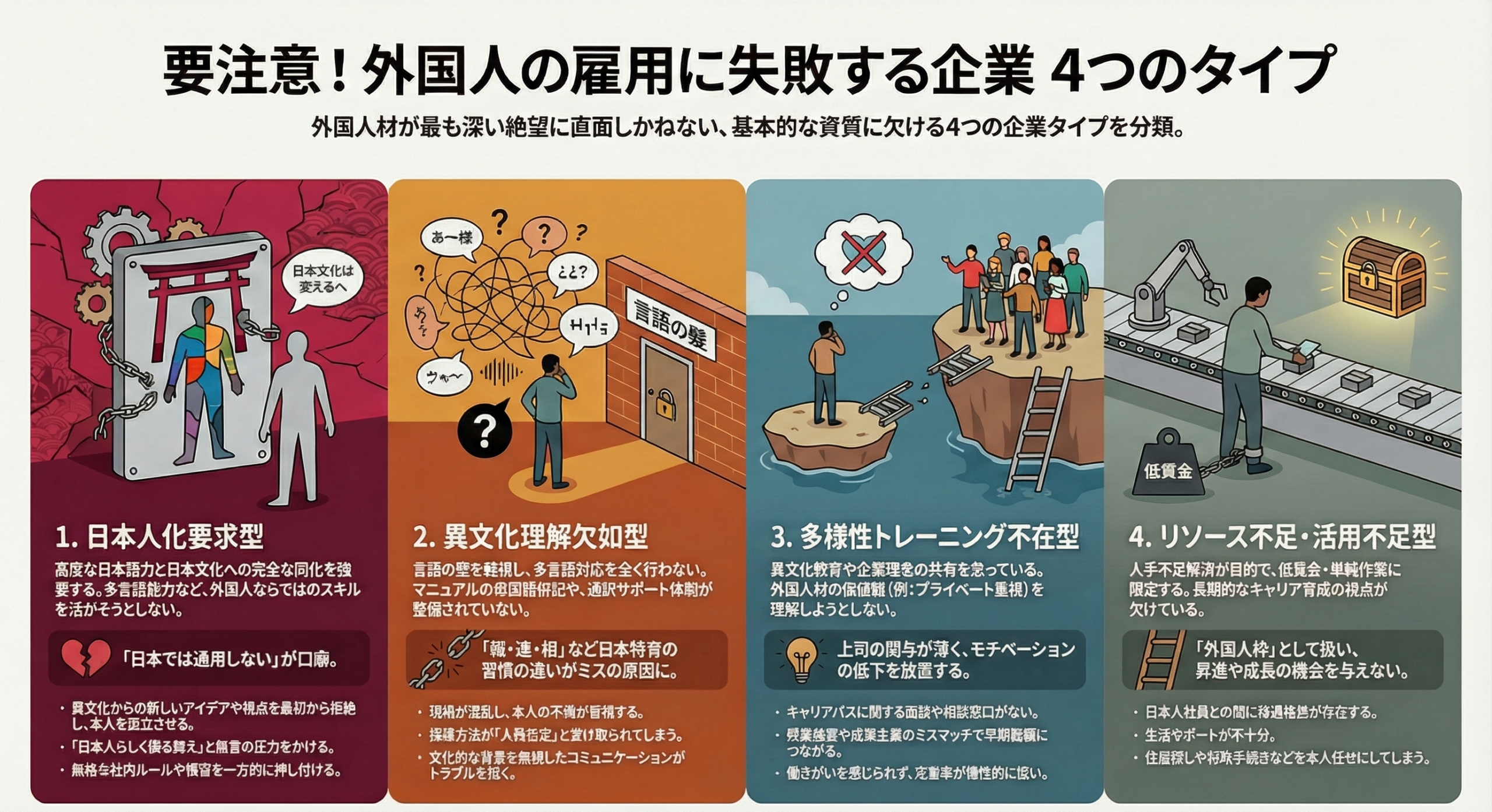
The types of companies that lack the basic qualities to hire foreign nationals are mainly those that are conspicuous by their lack of cultural understanding, communication support, diversity support, and training systems. These are cases that can easily lead to low retention rates and problems with foreign workers, resulting in hiring failures.
1. demanding Japanese-oriented companies that force cultural conformity
Not taking advantage of the unique skills (international perspective and multilingual ability) of foreign personnel,Refuse to change, seeking a high level of Japanese language skills and assimilation into Japanese corporate cultureDo.Rejecting ideas from other cultures as "not applicable in Japanand isolate foreign workers.
Example: a large manufacturing or heavy industry with strict internal rules and little flexibility.Pressure on foreign personnel to "act like Japanese!" and pressurePour over the
improvement plan
Implement training for multicultural understanding: Hold regular workshops on cross-cultural communication for all internal employees (e.g., twice a year, invite outside lecturers to learn cultural differences through role-playing). This reduces unconscious bias and fosters a culture that incorporates foreign perspectives.
Introduce a mentoring system: Assign an experienced Japanese employee as a mentor to support cultural adaptation through interviews. Strengthen individualized support, including religious and dietary considerations (e.g., provision of halal food).
Revision of internal policies: "Respect for diversity" was clearly stated in the corporate philosophy, and cross-cultural contributions were added to the evaluation criteria.
2. companies that lack cross-cultural understanding
Ignore the language barrier,Failure to provide business Japanese language education and multilingual support(2) The following are some of the most important issues to be addressed. Incorrect transmission of instructions and reporting, liaison, and consultation (hourensho).Mistakes are made due to differences in customsand cause on-site confusion. Dissatisfaction accumulates.
Examples: in small and medium-sized nursing care, food service, and manufacturing industries,No native language or interpretation systemMany troubles occurred due to differences in time concepts and hierarchical relationships.Teaching methods that foreign workers perceive as "personality denialbecame a problem.
improvement plan
Improvement of language environment: Internal documents and manuals were written in both English and native language, and translation tools were introduced. Provided a Business Japanese course as part of the initial training.
Interpretation and communication support: assign bilingual staff onsite or contract outside interpretation services. Utilize real-time translation using an app to prevent mistakes. Regular feedback meetings to resolve misunderstandings.
Embody cultural considerations: allow time off for religious events (e.g., flexible shifts during Ramadan) and organize multicultural events (e.g., international cooking parties).
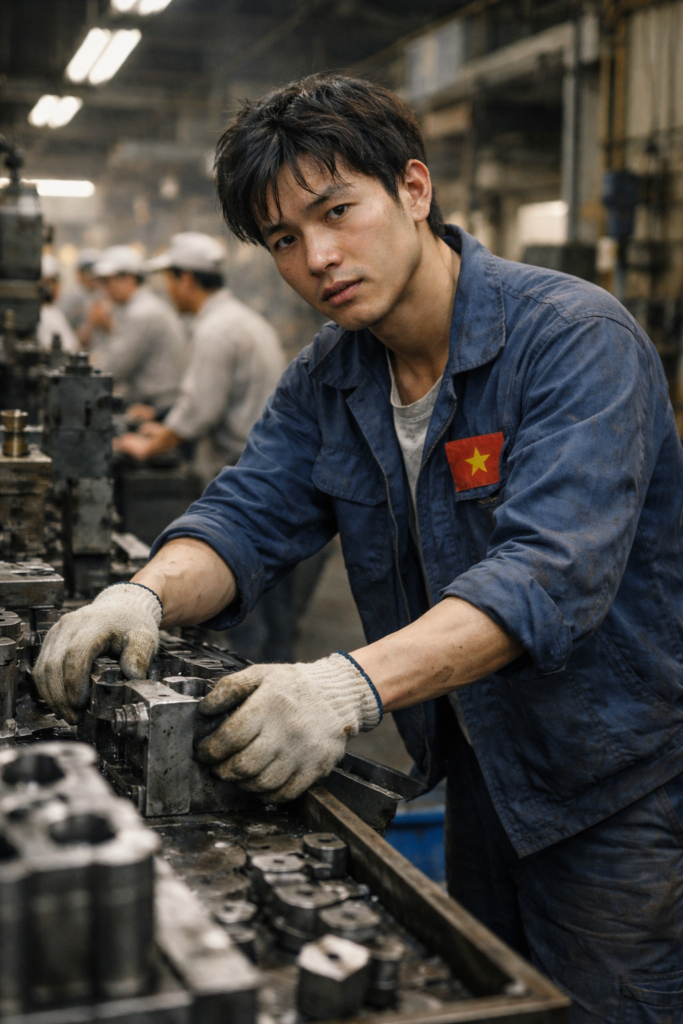
3. companies without diversity training
Failure to educate different cultures and share corporate philosophyand mismatches in forced overtime work and performance-based work that lead to job turnover.The company is not involved in the process of making the decision. Supervisor not actively involved,Leaving foreign personnel unmotivatedThe following is a list of the most common problems with the
Examples: in small businesses in the construction, agriculture, and lodging industries,Ignores private valuesIn addition, delays and poor retention rates have become chronic.
improvement plan
Establish a diversity training program: Mandatory online/offline training. Content will focus on eliminating bias and improving management skills.
Motivation management system: Goal-setting interviews are conducted within the first month of employment to create individual career paths. A consultation desk is set up and anonymous feedback is utilized.
Team building activities: Monthly social events outside of work. To improve retention rate.
4. resource-poor small businesses
Although they are hired for the purpose of solving labor shortages,Low wages and simple work for foreign personnel(2) The amount of the appropriation shall be allocated to the following
Example: The "Foreign Quota."and limited opportunities for promotion.
improvement plan
External support using resources: Establish a low-cost system using specialized consultants and government services (e.g., employment counseling for foreign nationals at Hello Work).
Reinforcement of livelihood and career support: from the time you join the company, we help you find housing and complete administrative procedures (e.g., registering as a resident, opening a bank account). Create career development plans and provide skills training.
Fair treatment: set wages and benefits equal to those of Japanese and clarify criteria for promotion.
These types are,A common weakness is that foreign employment is viewed only as "immediate" and long-term integration is not considered..
 日本語
日本語  English
  简体中文
简体中文  Français
  Español
  한국어
한국어  Tiếng Việt