
I will reply to you within 24 hours/.
Reinstatement from Permanent Disapproval: What Sole Proprietors Disapproved on Income Should Do Now to Reapply
They contribute to the community and pay their taxes and social insurance perfectly. Nonetheless,My application for permanent residence was denied simply because of my "low income (income)." ......
In fact, we receive no end of such earnest inquiries from sole proprietors, family business owners, or those with "spouse of Japanese national, etc." enrollment status.
Why?" You may be in a state of shock. However, there is no need to give up. If you correctly understand the criteria of the Immigration Bureau and take appropriate measures,It is quite possible to recover (reapply or reinforce reasons) a decision of disapproval.
In this article, we will explain the specific steps that should be taken next by those who have been denied permanent residence due to income.
TOC
1. why is a "Japanese spouse" or "community contribution" dropped in income?
Screening for permanent residence, especially for sole proprietors and business owners, has become very strict in recent years.
The essence of the "livelihood requirement" checked by the Immigration Bureau is "whether or not the applicant can lead an independent and stable life without relying on Japanese social security (welfare, etc.) in the future.
Points easily misunderstood in the screening process
- No "unpaid" does not = "permitted."
- Paying taxes, pension and health insurance for 8 years without a single late payment is an excellent track record (National Interest Conformity Requirement). However, it is only "no negative evaluation" and is seen separately from the positive evaluation that guarantees "future stability".
- Gap in perception of "household income
- In many cases, sole proprietors and owner-operated companies keep their "income (income on tax certificates)" low by saving taxes and including them in expenses. The Immigration Bureau examines the income on the tax return, so even if they are actually making a living, they are judged to have a "low income" on the documents.
2. "Three Recovery Steps" to Reverse Disapproval
There is no need to panic just because you have received a notice of disapproval. The following steps will help you calmly take action.
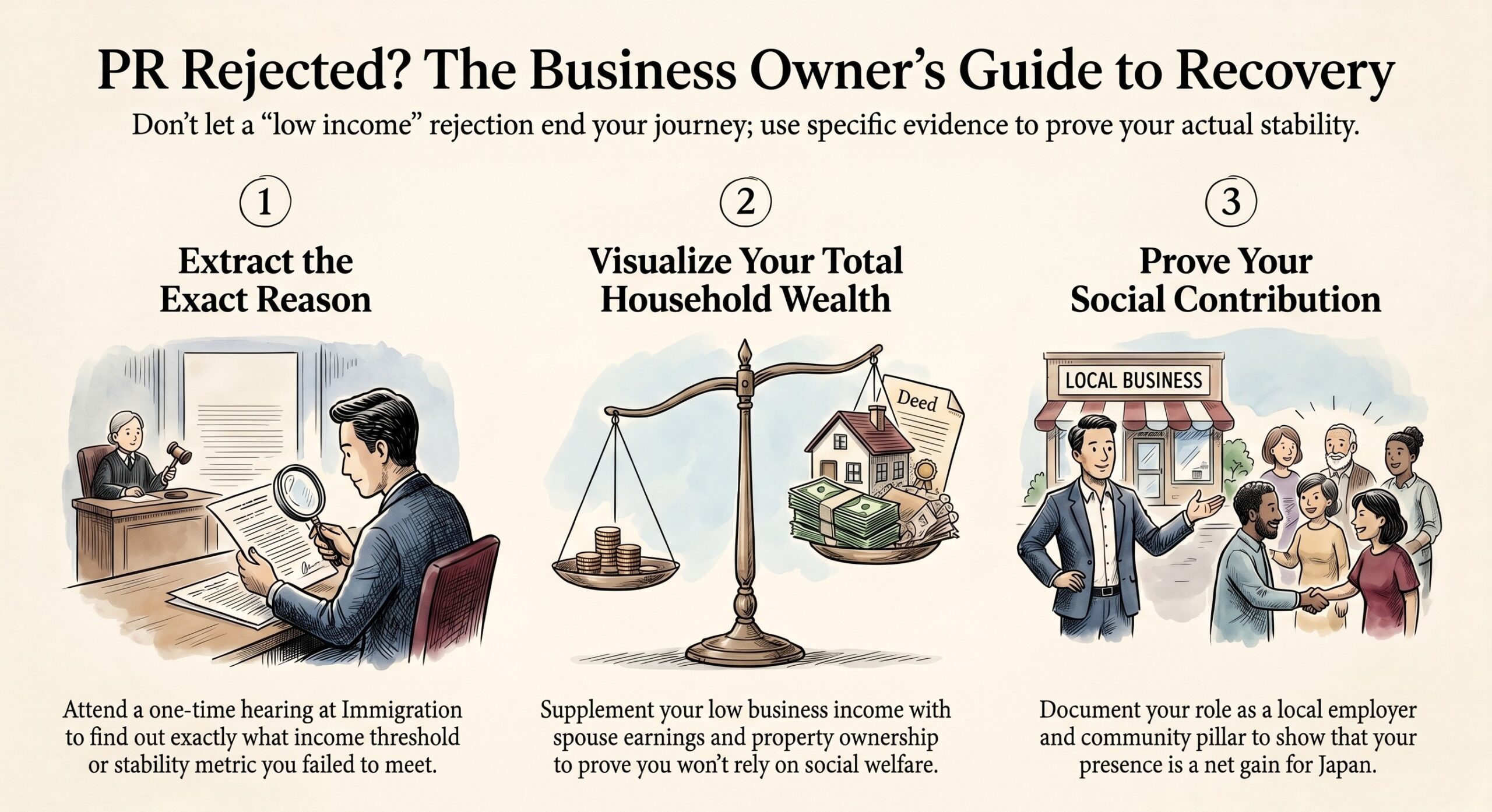
Step 1: Go to the immigration office and identify the real "reason for inadmissibility" (most important).
First, the immigration inspector will directly hear the reason for the disapproval.
*Caution: The chance to tell us why is...In principle, one time onlyIt is. In addition to simply being told that "income was insufficient," it is necessary to ask questions that get to the heart of the matter, such as "How much more was missing in concrete terms? Our firm also provides support for accompanying the immigration authorities to hear the reasons for this.
Step 2: Visualize all "hidden assets and income" of the entire household.
Thoroughly identify factors that can be covered even if the person's business income is low.
- Spouse's income: If the wife (or husband) has income from another job (e.g., teaching, part-time work, side hustle, etc.), it should be added up as an important pillar of household support, not just "spending money," and proof documents (withholding tax slip or tax return) should be submitted.
- Proof of Assets: Owning a home (home real estate) is an extraordinarily positive evaluation that you do not have to pay for housing and that you have a solid foundation in Japan. This is officially proven by a certificate of registered matters, etc.
Step 3: Verbalize and promote your business's "contribution to the community".
The numbers on the immigration forms (financial statements and tax returns) alone do not tell you how much your business is loved by the community.
- Japanese Employment ExperienceThe fact that we hire Japanese employees and protect their employment is a clear contribution to Japanese society.
- Role in the community: The business has become an integral part (staple) of the local community, and the "statement of reasons" will be emotional and objective, with photos, storefronts, and sometimes testimonials from the local community.
 日本語
日本語  English
  简体中文
简体中文  Français
  Español
  Tiếng Việt
  한국어
한국어