
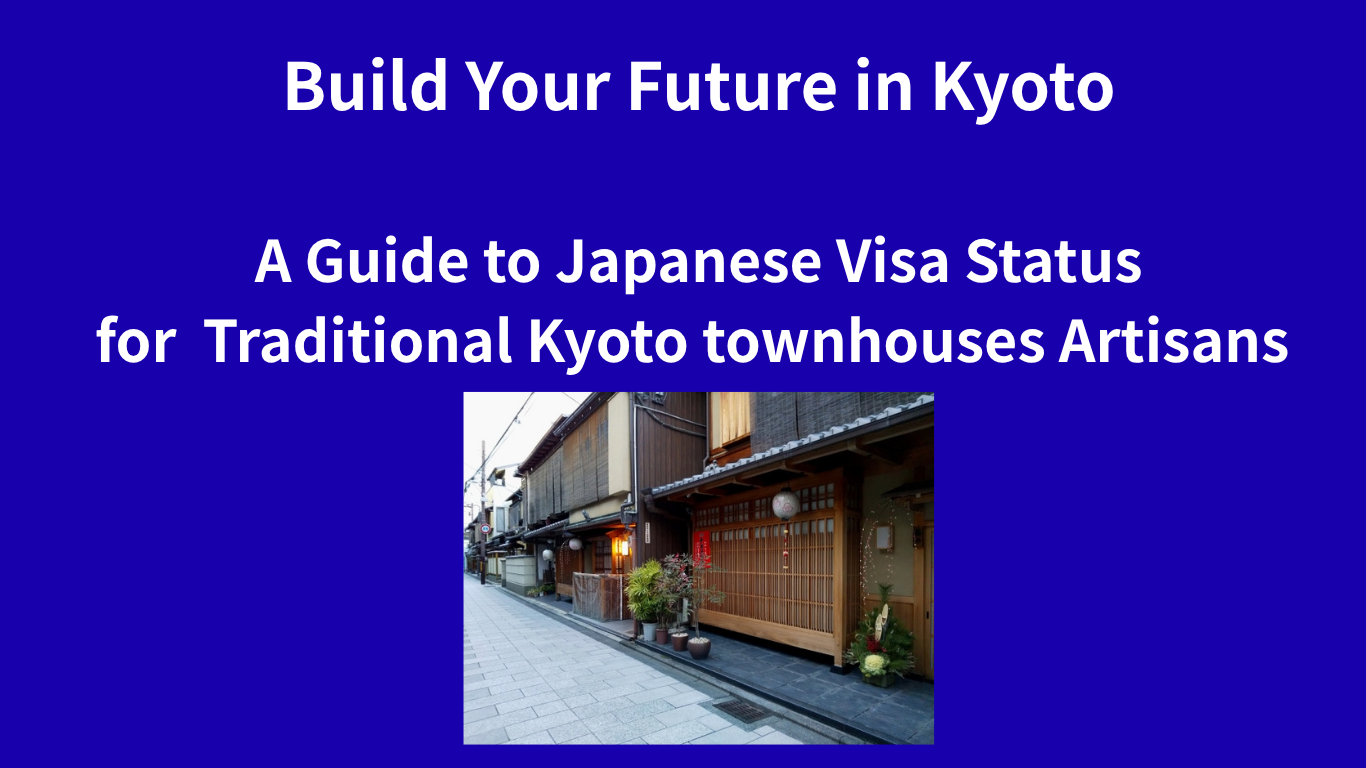
Build Your Future in Kyoto – A Guide to Japanese Visa Status for Machiya Artisans and Staff
Voice-over commentary
Preserving Tradition: Your Path to Working in Kyoto Machiya Construction
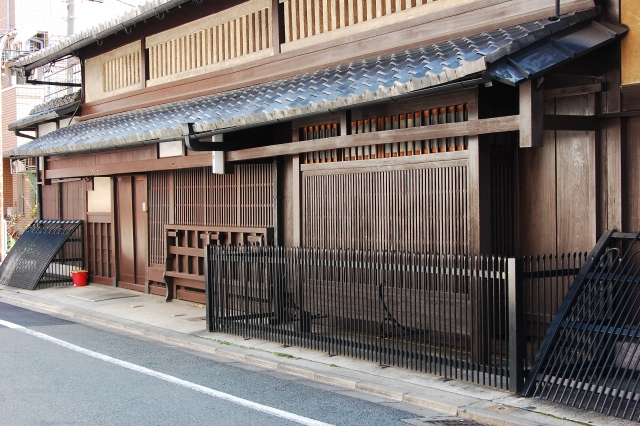
Kyoto’s Machiya (traditional wooden townhouses) are more than just buildings; they are living testaments to Japan’s exquisite craftsmanship and cultural history. For a skilled carpenter (Daiku) or a passionate professional seeking an administrative role, the opportunity to work in Machiya preservation is profoundly rewarding.
If you are an international applicant aspiring to join us in sustaining this heritage and shaping its future, understanding the necessary Status of Residence (Visa) is the crucial first step to working in Japan.
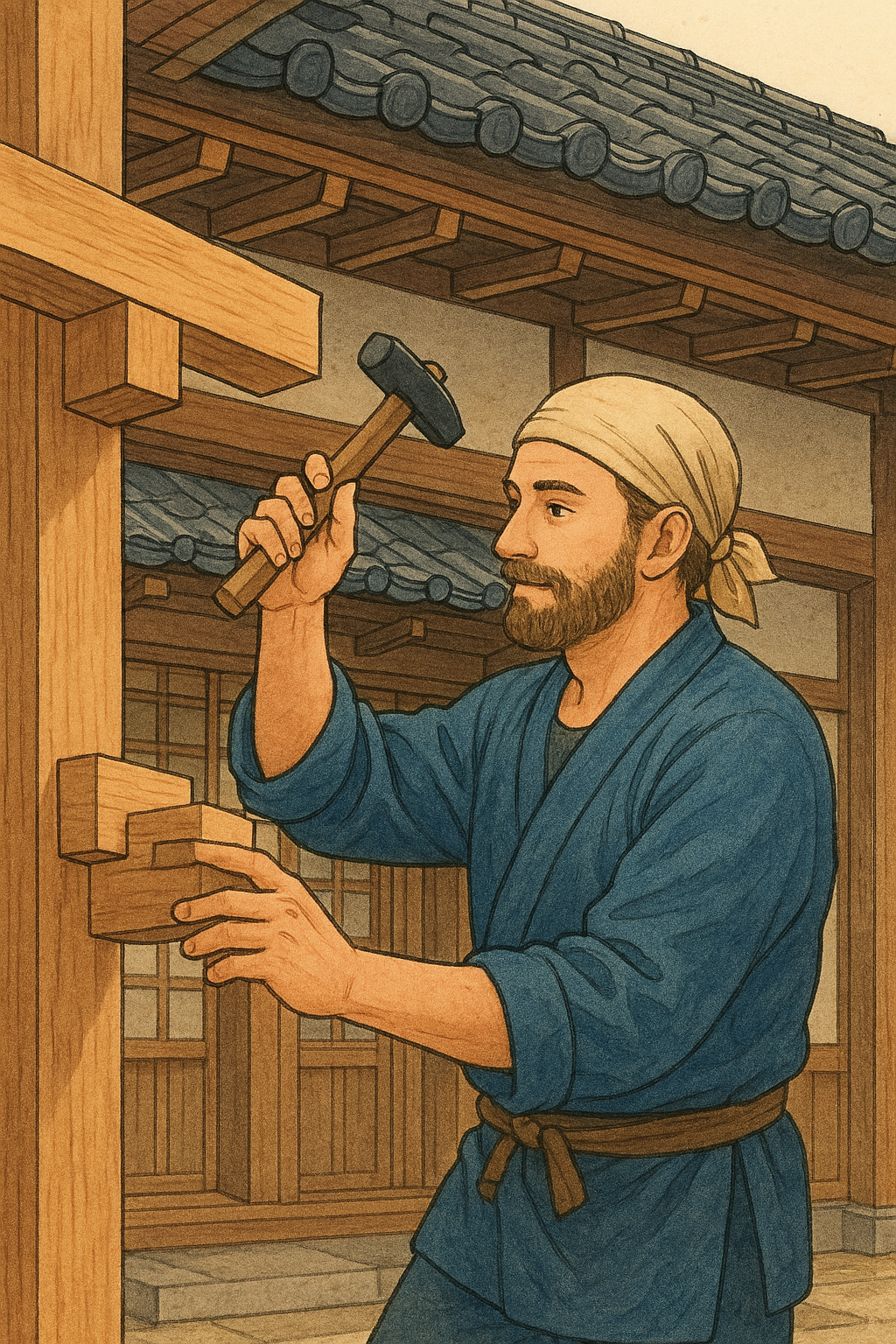
🏗️ Visa Categories for Carpenters and Skilled Workers (Artisans)
For those applying to work directly on-site as a Machiya carpenter or artisan, the following residency statuses are the most common pathways:
1. Specified Skilled Worker (特定技能 / Tokutei Ginō)
This status was created to address severe labor shortages in specific Japanese industries, including construction.
- Field: Construction Sector.
- Feature: It welcomes foreign nationals possessing a considerable degree of knowledge or experience in a specific field. Traditional trades like Machiya carpentry can be evaluated under this framework.
- Requirements:
- You must pass a skills test and a Japanese language proficiency test.
- The maximum period of stay is 5 years in total (for Type 1).
2. Skilled Labor (技能 / Ginō)
This visa is designed for individuals engaged in work that requires skilled labor in specific industrial fields.
- Field: Applicable to traditional and specialized skills, such as specialized cooking, or in this case, highly skilled traditional architectural techniques.
- Feature: This status is often suitable if you possess advanced techniques or many years of practical experience as a master Machiya carpenter.
- Requirements: Applicants must generally possess at least 10 years of practical experience in the relevant skill (5 years for specific activities).
📝 Visa Categories for Administrative and Professional Staff
If you are applying for specialized office roles such as planning, design, administration, or sales within a construction company, the following visa is standard:
3. Engineer / Specialist in Humanities / International Services (技術・人文知識・国際業務)
This is the most common status for accepting foreign nationals into technical and professional office-based roles.
- Job Scope: Includes site management and supervision (construction management), architectural design, accounting/general affairs, and international relations for handling foreign clients.
- Requirements:
- You must possess an academic background (e.g., a university degree) or practical experience relevant to the duties you will perform.
- The activity must be based on a contract with a public or private organization in Japan.
📌 Essential Points to Know
Qualifications are Not Mandatory, But Beneficial
While there are no legally mandated qualifications to work as a carpenter in Japan, obtaining the following national qualifications can serve as a testament to your technical abilities, which is beneficial for your visa application and career advancement:
- Architectural Carpenter Skill Test (建築大工技能士): A national qualification certifying the level of carpentry skill.
- Wooden Building Architect (木造建築士): A national qualification for designing and supervising wooden buildings.
Bringing Your Family
Foreign nationals holding a qualified work status (such as Skilled Labor or Engineer/Specialist in Humanities) may be able to apply for a “Dependent” (家族滞在 / Kazoku Taizai) Status of Residence for their spouse and children (generally not applicable to Specified Skilled Worker Type 1).
➡️ Contact Us Today
The appropriate Status of Residence depends critically on your career history, practical experience, and the specific job duties you will perform within our company.
We are committed to fully supporting your career in Japan. Please share the details of your skills and experience with us. We will guide you through the appropriate visa procedures, collaborating with immigration experts.
We eagerly await your application—a passionate artisan ready to embrace this timeless craft!
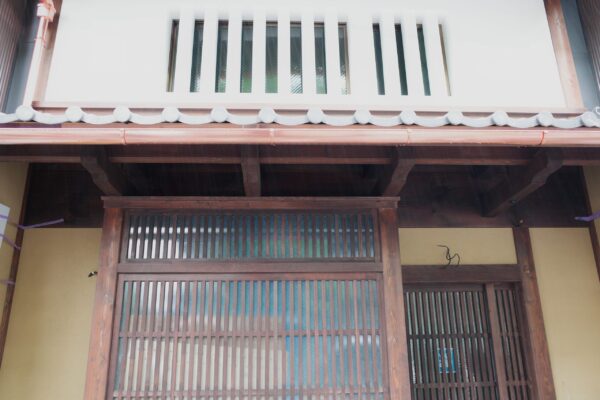
I was fortunate to have the opportunity to see the construction site of a newly built Kyo-machiya.
Until now, whenever I thought of a “Kyo-machiya,” I primarily associated it with renovation and preservation, believing that new ones were no longer being built. However, witnessing the construction of a new Kyo-machiya—quietly, yet surely, built with a definite purpose—filled me with great hope for the fact that the “Kyoto landscape” is being rebuilt for the future.
We believe the following project is essential for the preservation and maintenance of Kyomachiya (traditional Kyoto townhouses).
🏡 Kyomachiya Co-Creation Project – From Kyoto to the World
~ An International Co-Creation Architecture Project Connecting Tradition to the Future ~
1|Project Objectives (Expected Outcomes)
- International Succession of the traditional techniques and values of Kyomachiya (traditional Kyoto townhouse) construction firms.
- Cultural Exchange and Regional Revitalization through young people, primarily from North America.
- Authentic Acquisition of Japanese Traditional Architectural Techniques by young foreign craftspeople.
- Establishment of a “Co-Creation Model” (creating new value) for traditional industries, originating in Kyoto.
- A project that “Nurtures the Successors of Culture” from Kyoto to the world.
2|Project Outline
| Item | English Translation |
| Base/Location | Utilization of a historically significant Kyomachiya within Kyoto City, following its renovation. |
| Host Organizations | Local construction firms specializing in Kyomachiya + collaborating companies/organizations. |
| Participants/Target | Young adults (20s to 30s) from the U.S. and Canada who are interested in architecture and culture. |
| Activities | On-the-Job Training (OJT) in Kyomachiya construction work, communal living in a machiya, and information dissemination activities. |
| Craftsperson Certification System | Visualization of technical succession and assurance of credibility, proving a certain level of skill. |
| Visa/Residency Status | Utilizing statuses such as “Specified Skilled Worker” (Type 1 and 2). |
 日本語
日本語  English
  简体中文
简体中文  Français
  Español
  한국어
한국어  Tiếng Việt