
Treatment of "Japanese Customers" for Specified Skilled Foreigners
Voice Explanation
Treatment of "Japanese Customers" for Specified Skilled Foreigners
b6c0636fcc51442c02a681b20c0a600aIntroduction: Understanding Japanese Service Culture and Omotenashi
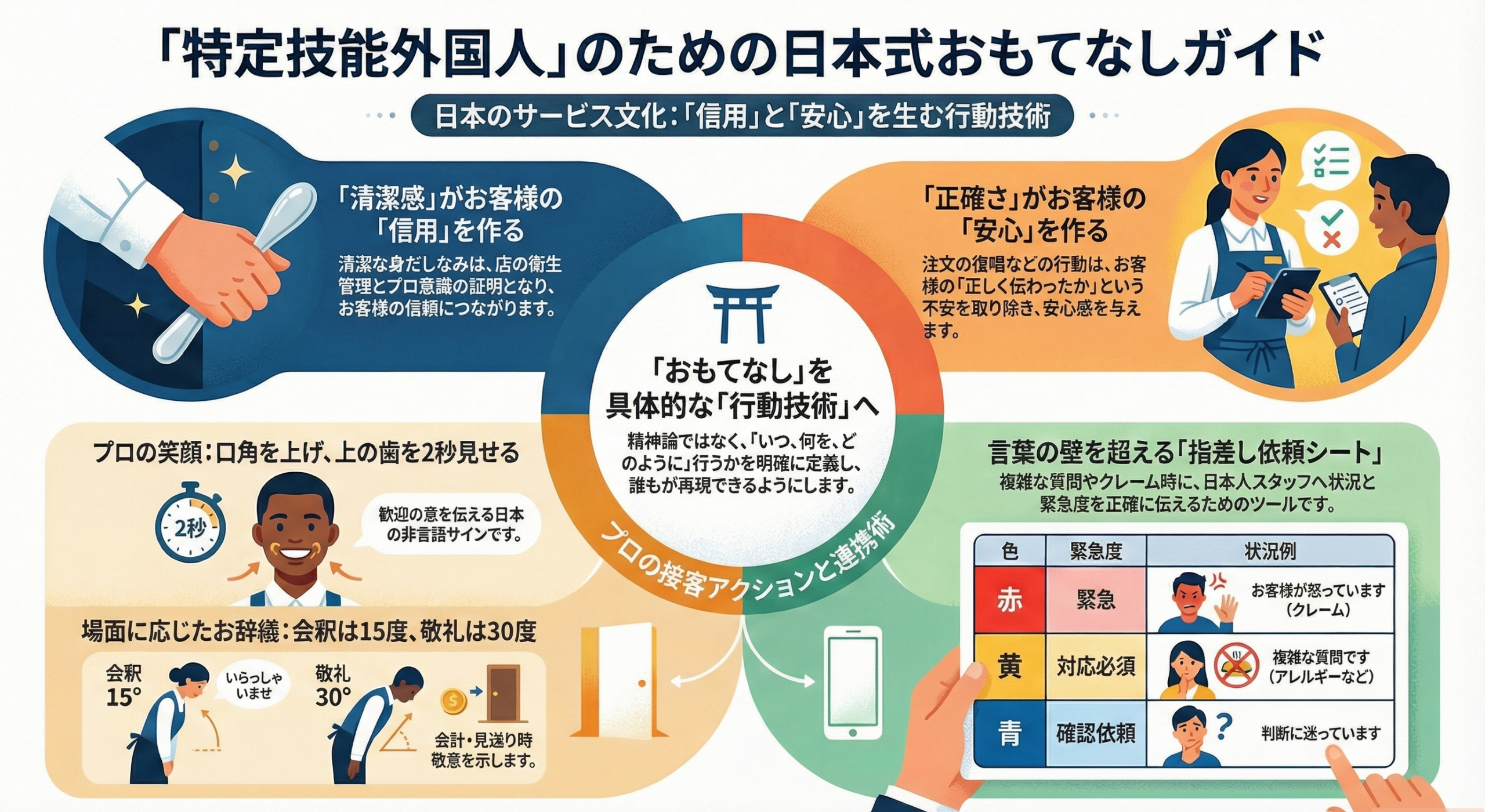
1. from mentalism to "action technology
Japanese service (omotenashi) is not just about being nice, but also about anticipating customer expectations andSpecific ActionsThis is a technology that is realized in the following way. In this material, vague instructions are abolished and all customer service is mastered as "behavioral techniques" that can be evaluated and reproduced.
| point of view | Conventional abstract instructions | Instruction in this material (behavioral techniques) |
| Target | With all my heart and a smile." | Clarify the "who," "when," "what," and "how." |
| Why | There are many things we don't teach. | Teach a set of "Japanese cultural expectations" and "hygiene risks" behind the behavior. |
2. Basic philosophy of Japanese service: trust and security
Japanese restaurants require a high level of "cleanliness" and "accuracy.
- Cleanliness = Trust: Grooming, environment, and sanitation give customers the confidence that the restaurant is safe and professionally staffed.
- Accuracy = peace of mind: Recapitulation of orders and confirmations removes customer anxiety and provides reassurance that they have been conveyed correctly.
Chapter 1: Basic Professional Behavior and Grooming (Cleanliness)
Here, students learn behavioral techniques related to "preparation" and "hygiene" before interacting with customers.
1. professional appearance (credibility with customers)
| Item | Behavioral techniques (specific actions to be taught) | Why |
| uniform | Check daily for wrinkles and stains and fasten all buttons. Wear the nameplate straight in the designated position. | Dirty uniforms give the impression of poor hygiene and make customers uneasy. |
| Hair and nails | If hair is long, tie it completely and cover it with a net. Keep bangs out of the face.Nails should be cut shorter than the finger tips, and nail polish is prohibited.The following is a list of the most common problems with the | Responsibility as a professional food handler to prevent contamination by foreign substances. A clean appearance leads to a sense of security. |
| Makeup and Perfume | Avoid heavy makeup and strong perfumes (especially for women). Anything that interferes with the aroma of food is strictly prohibited. | It is a "thoughtfulness" that does not interfere with the meal. |
2. hygiene management (food poisoning prevention and security)
| Item | Behavioral techniques (specific actions to be taught) | Why |
| water (or basin, etc.) for washing one's hands | After toileting, before and after cooking, after paying the bill, and at other times as specified.More than 30 secondsWash carefully between fingers, nails, and wrists. | The most important preventive measure to avoid bringing in foodborne bacteria and viruses. |
| Coughing and sneezing | When coughing or sneezing, out of sight of customers.Always cover your mouth with the inside of your elbow.The following is a list of the most common problems with the | Prevent the spread of viruses through droplets. Demonstrate good hygiene to customers. |
Chapter 2: Breakdown and Acquisition of Customer Service into "Behavioral Techniques"
Students will learn the behaviors specifically required for Japanese service, broken down into specific techniques.
1. welcoming and sending off (first and last impressions)
| Item | Behavioral techniques (specific actions to be taught) | Why |
| smile | The moment you make eye contact with a customer,Raise the corners of your mouth and show your upper teeth for 2 secondsThe following is a list of the most common problems with the | Professional non-verbal signs in Japan that convey welcome. |
| bowing | When saying "Irasshaimase (Welcome)," the upper body should be bent at a 15-degree angle (bail). When paying the bill or seeing someone off, bend your upper body at a 30 degree angle (salute). | Japanese manners to show respect for the occasion. |
| farewell | Stand upright at the entrance until the customer is out of sight. | Express gratitude to the customer until the last moment and maintain professionalism and awareness. |
2. customer service (accuracy and care)
| Item | Behavioral techniques (specific actions to be taught) | Why |
| Call handling | When the call button is pressed, "Yes!" and answer,walking quickly instead of runningI'm on my way. | Efforts not to make people wait (fast walking) and safety considerations (not running) are both important. |
| Order Confirmation | After receiving the order, the staff member points and confirms the order, saying, "00 and 00, is that correct? Is that all right?rehearsalDo. | Provide reassurance to customers who feel insecure about whether their orders were accurately conveyed. |
| Culinary offerings | Recite the name of the dish,(with) both handsof the table in theright rearProvide (in principle) from | Show respect to customers and ensure safety on the flow line. |
| setting meal for someone | Promptly finish the plates after the guests have finished eating, before the tables become crowded,quietlyLowering. | The "thoughtfulness" of making space at the table and making the next dish and after-dinner time comfortable. |
Chapter 3: Environmental Maintenance (Maintaining Cleanliness)
These are behavioral techniques related to the "environment" to maintain the comfort of customers.
1. maintain tables and seating
| Item | Behavioral techniques (specific actions to be taught) | Why |
| table cloth (e.g. table cloth, slippers, etc.) | Avoid all cutlery and use a wet cloth → dry cloth.twice wiping with a clothThoroughly implement the following | It meets the Japanese cultural standard of feeling unclean when water droplets remain, and prevents the growth of bacteria. |
| Cleaning the floor | Any trash (napkins, food scraps) that falls in the customer aisle or under tables,Within 3 minutes after discoveryindicates such things as location of person or thing, location of short-term action, etc.Keep a low profile.Clean up (spot cleaning). | Attentiveness" to ensure that customers do not have to see anything unpleasant. |
| Preparation after cleanup | When the customer leaves, the next set (cutlery, menu)Perfect conditionQuickly adjust with | Ensure that the next customer does not wait and is always greeted in the best possible manner. |
2. management of out-of-sight areas
| Item | Behavioral techniques (specific actions to be taught) | Why |
| Toilet check | Once per hourBased on the checklist, check and record whether there are any water droplets on the mirror or floor, and whether the trash can is full. | The cleanliness of restrooms is directly related to the credibility of the restaurant. As professionals, we take responsibility for areas that customers cannot see. |
Chapter 4: Practice and Collaboration (with Japanese staff)
Understand the environment and role of specific skilled foreign human resources in the workplace.
1. customer service rehabilitation and step-by-step learning
- At first, "Welcome," "Thank you," "Excuse me," etc.Short-form customer service onlypositions (e.g., ushers, serving staff, etc.) to begin with.
- Get used to the customer's gaze and the atmosphere of the restaurant in a **"low-load position "** with veteran Japanese staff nearby to support you.
2. role assignment for cooperation
- Role of foreign personnel: Learn behavioral skills honestly and demonstrate a high level of professionalism, especially in tasks in which they excel (cleaning, serving, etc.).
- Role of Japanese staff: As a "cross-cultural mentor (advisor)" rather than a "guidance counselor" for foreign personnel, the program will address cultural questions and concerns in Japan and provide gentle support.
3. tools to overcome language barriers
- When receiving complaints or complicated questions (allergies, discounts, etc.), do not try to solve them yourself, but always promptly ask for help from Japanese staff using a "finger pointing request sheet" or simple Japanese.
The purpose of this sheet is not to communicate with Japanese customers, but to coordinate with Japanese staff (request for help) quickly and accurately.
📄 Specific instructions on the pointing request sheet (help call sheet)
1.1 Purpose and usage scenario of the sheet
| Item | Description. |
| Objective. | In an emergency or difficult-to-respond-to situation for foreign staff, regardless of Japanese language ability,Inform Japanese staff of the exact situation and necessary actionsThings to do. |
| Usage Scenes | 1. when receiving complex questions or complaints from customers. 2. When a problem occurs that is beyond his/her judgment (machine failure, sudden illness, etc.). 3. when it becomes difficult to explain in Japanese. |
| usage rules | Point to the item closest to your situation, take the sheet to the Japanese staff member, and say, "Please help (help)I tell them, "I'm sorry. |
2. Components of the sheet
The sheet consists of the following three sections, **"Who (I)がWhat problem(s) are you facing?"to,Design the system so that it can communicate "who you want to help (request) "** in an instant.
Section A: [Urgency/Situation Report] (top)
Identify urgent problems and events that require urgent action by color coding.
| 色 | Item | Situations / Japanese Phrases |
| 赤 | emergency | Customer is angry (complaint) / Customer appears to be ill / Equipment (cash register, cooking utensils) has malfunctioned |
| 黄 | Support required | It's a complicated question (allergies, discounts, etc.) / Asked for technical details (ingredients, place of origin, etc.) / Too many orders to understand |
| 青 | Confirmation Request | Mr. 00 is calling for you / A customer is waiting for you (waiting to be seated) / Not in trouble, but I am at a loss to decide |
Section B: [Description of specific problem] (Central)
Point to the specific category of problem the customer is asking about.
| category | Item | Situations / Japanese Phrases |
| Customer Requests | Asked about allergies (specifically) / Asked about discounts and coupons / Asked about changing or canceling reservations / Asked about He asked for more cold water.(If you cannot handle it yourself) | |
| In-store issues | Toilet is dirty (needs immediate attention) / Large debris or puddles on the floor / Other customers are having problems with each other | |
| Ordering & Checkout | It was pointed out that the wrong dish was delivered / an off-menu item was ordered / the bill was not correct. |
Section C: [Details of request to Japanese staff] (bottom)
Tell the Japanese staff what you want us to do.
| Item | Request / Japanese phrase |
| Response. | Please switch with me immediately.(I want you to take over complete customer service) |
| Interpreter, please. | We do not understand the customer's language.Please speak on my behalf. |
| Description. | I understand, though,Please explain to the customer instead. |
3. flow of sheet use (for role-playing)
- Problem: The Foreign staff receive difficult questions from customers (e.g., about allergies).
- Status: The foreign staff decided that "this is a complicated question" and put "Yellow: must be handled" on the sheetandFinger on "About Allergies."
- Help Request:. Take the sheet, go to the nearest Japanese staff member (mentor), show him the sheet, and say, "Help, please!I tell them calmly, "I'm sorry.
- Linkage:. The Japanese staff sees the item pointed to (yellow: must be handled, allergy), immediately grasps the situation, points to "Please replace me immediately "** on the **sheet, and says, "Okay. I'll replace you right away," and move on to customer service.
4. production notes
- Durability Laminated or thicker paper should be used for on-site use.
- Multilingualization The main items on the sheet (urgent, required response, etc.) are for foreign staffnative-language tickers.The speed of decision making in an emergency will be improved if it is also noted.
- Size: 1.5 Ideally, the size should be small enough to fit in an apron pocket (about A5), but consider making the letters large enough to be easily read.
How to proceed with the training
It is recommended that this material be utilized in the following ways
- Watch the video manual:. Review each behavioral technique (Chapter 2) repeatedly with model videos of Japanese staff.
- Use of checklists with photos:. Work with visuals to confirm standards of cleanliness (Chapters 1 and 3).
- Role-Playing: Role-Playing Use workplaces and breaks to practice the behavioral techniques in Chapter 2 with Japanese staff and receive immediate feedback.
 日本語
日本語  English
  简体中文
简体中文  Français
  Español
  한국어
한국어  Tiếng Việt