Specified Skilled Foreign Human Resources Cannot be Used as a Workforce! The Future of Restaurant Operations: Overcoming the Barriers of Omotenashi and Cooperation
Voice Explanation
For Japan's food service industry, specially skilled foreign human resources are a "hopeful star" to solve the serious labor shortage. However, many restaurant operators are facing a "more difficult obstacle than imagined. It is not just a matter of skill or Japanese language ability.
Japanese customers look for "Omotenashi" (hospitality), a smile, and a sense of cleanliness,Progress in acquiring basic customer service rules rooted in Japanese service culture.This is a problem. In addition, there are problems with cooperation with Japanese part-time workers, resulting in a vicious cycle that keeps customers away.
This column takes an in-depth look at the specific challenges of this "hospitality barrier" and "cooperation barrier" and discusses the fundamental measures that management should take.
1. "Scolding does not improve the situation" - Difficulty in customer service instruction for foreign personnel
What bothers restaurant operators the most is the "low level of service" to which Japanese customers are sensitive.
- Misplaced notions of "Omotenashi":. For foreign employees, "smiling" is an expression of private feelings, and the "professional smile" and "eye contact" required at work may be difficult for them to understand.
- Cleanliness" in different cultures:. The standard of "cleanliness," which is considered an unspoken rule in Japan, differs greatly from country to country, including the way chopsticks are placed, the way tables are wiped, and the way uniforms are worn.
- The Counterproductive Effects of "Scolding":. In many cases, when managers give "scolding" guidance in situations where service is lacking, due to cultural backgrounds and language barriers, this is perceived as mere "pressure" or "fear" and does not lead to improved behavior. The same teaching methods used by the Japanese only serve to lower the motivation of foreign personnel.
2. customer psychology that shuns "all foreigners
When customers choose a restaurant, they place importance not only on the quality of the food, but also on the "comfort" of the restaurant.
- Gap with customer "expectations":. Japanese customers expect a high level of customer service from restaurants. If they feel uneasy about the level of service when they see only foreign employees in a restaurant, they tend to feel that "this is not the restaurant they are looking for" and hesitate to enter.
- Communication concerns:. Concerns about whether orders and questions can be accurately conveyed and whether urgent requests can be handled are also major factors that cause customers to avoid restaurants with a high percentage of foreign employees.
3. "Cooperation barrier" that prevents Japanese part-timers from taking hold
Hiring Japanese part-timers to solve service problems caused by foreign employees will now create new problems.
- Increased burden of leadership:. Japanese part-timers are unknowingly assigned the role of "mentor" to foreign employees, which causes stress due to unfamiliar cultural differences and language barriers.
- Value Conflicts:. Conflicts of values arising from differences in culture and upbringing, such as attitudes toward work and punctuality, have created a serious "mismatch" between Japanese part-time workers and foreign workers, who quit because they find it "difficult" to work.
4. fundamental solutions that management should now address
To break this vicious cycle, restaurant managers need to fundamentally rethink their teaching methods and work environment.
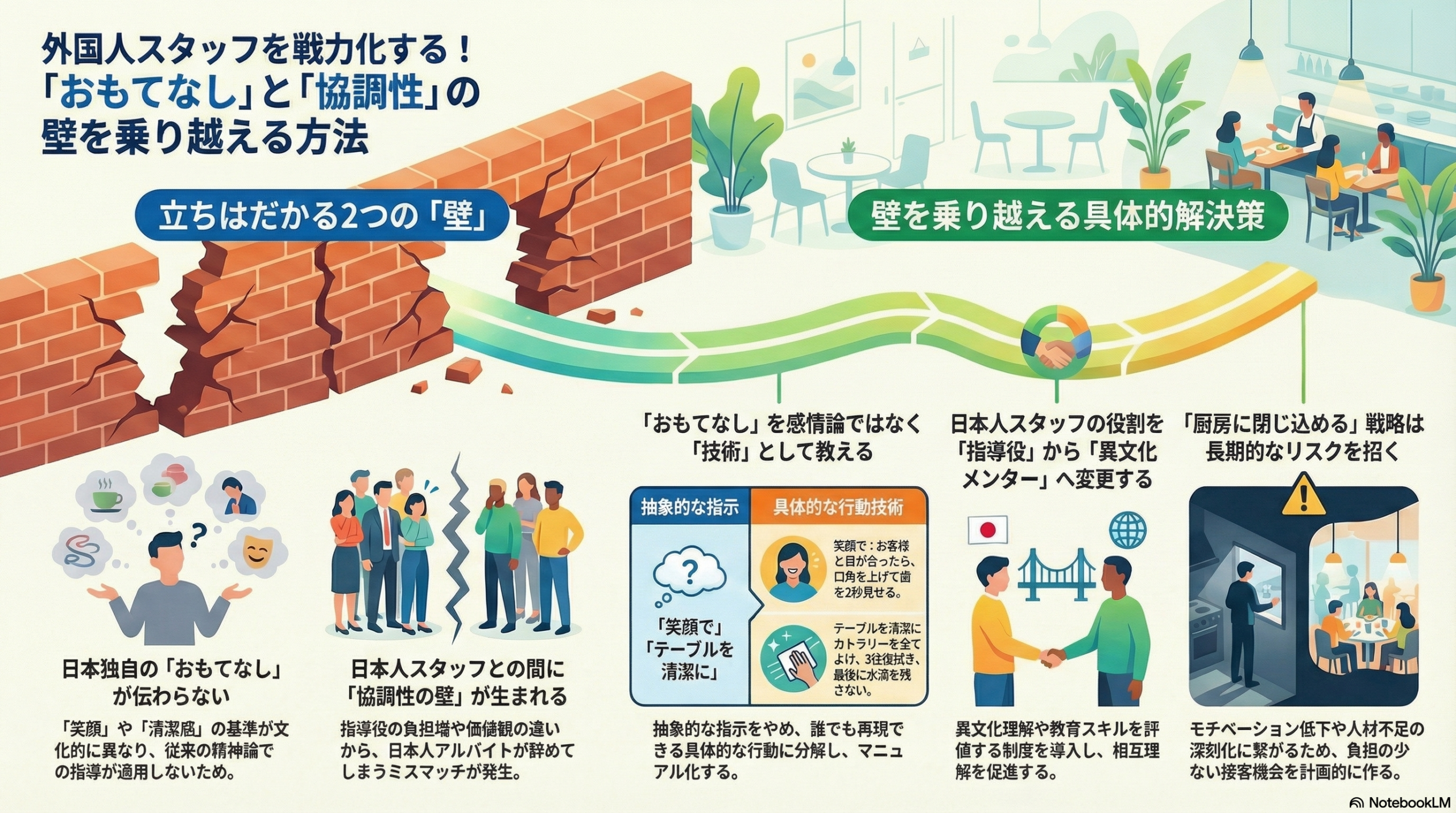
Solution 1: Deconstruct and verbalize services instead of "emotionalism".
Abolish abstract instructions such as "smile" or "be polite."Visualization of manuals and specific standards of conduct."We will ensure that the
- Example: Smile: "The moment your eyes meet the customer's, raise the corners of your mouth and show your teeth for two seconds."
- Example: When wiping the table, wipe three times, avoiding all cutlery. Make sure there are no water droplets left on the table."
Omotenashi" is not a cultural theory, but a skill that can be evaluated and mastered by foreign employees.
Solution 2: Promote "role-sharing" and "mutual understanding" between foreign and Japanese personnel
A system will be introduced in which Japanese part-time workers will be given the role of "cross-cultural communicators" rather than "instructors," and foreign employees will be assigned "mentors" (advisors) from Japanese materials to help them learn about Japanese service culture.
- Not "guidance" for Japanese materials,Introduced a system to evaluate "cross-cultural understanding and teaching skills.and improve cooperation.
- It is also effective to limit the work to "hours and positions with low customer service load," such as cooking assistance and cleaning work, for example, where foreign personnel can play an active role.
5. Aiming to create a workplace where Japanese and non-Japanese personnel can "grow together
Hiring specific skilled foreign personnel is not just "filling in" the labor force. In order to make them a true asset to the workforce, management must make an effort to translate Japanese service culture into different cultures and educate them.
The key to the future of Japanese restaurants is to transform the customer service manual into a "common language that transcends cultural barriers" and to create a workplace where Japanese and non-Japanese personnel can recognize each other's strengths.
6. Customer service education for foreign human resources with specific skills
1. limitations of conventional "spiritual and cultural" education
The instruction that fails in many restaurants is to end up with abstract instructions such as "have a spirit of hospitality" or "smile and be polite.
- Wall of ambiguous concepts:. Unique Japanese spiritual concepts such as "omotenashi" (hospitality) and "mindfulness" are difficult to translate for personnel raised in other cultures.
- Misinterpretation of leadership intent:. Actions that Japanese employees do unconsciously (e.g., noticing the customer's gaze, immediately lowering an empty plate) are not "natural" to non-Japanese employees, so when instructors scold them, "Why can't you do it? This will not lead to improvement.
- Emotional coercion:. Forcing them to "smile" leads to a sense of discomfort for them that they are being forced to fake their emotions at work, which in turn reduces their motivation.
2. 3-step education to break down and standardize as "behavioral technology
In order to effectively train foreign personnel with specific skills, it is essential to break down and standardize customer service as "specific behavioral techniques that anyone can replicate.
Step 1: Increase the "resolution" of services (clarification)
The most important standards of customer service behavior are broken down and verbalized to the extreme.
| Abstract Instructions | Behavioral techniques (specific behaviors to be taught) |
| smile | 1. eye contact with the customer (eye contact) 2. raising the corners of the mouth by 0 mm (physical) 3. holding the position for 3 seconds (time) |
| (sense of) cleanliness | Avoid all cutlery on the table at once 2. wipe 3 times back and forth with a wet cloth 3. finish with a dry cloth so that no water droplets remain |
| Order Confirmation | When reciting, point and confirm while repeating 2. |
Step 2: Teach a set of "whys" (conviction)
Teaching a set of reasons behind behavioral techniques, such as "Japanese customer expectations" and "hygiene risks," will increase the sense of conviction and retention in the work.
- Example (cleanliness):. Why do you need to wipe twice?" → "Why do we need to wipe twice?"This is because Japanese summers are very humid, and customers feel uncomfortable if water droplets remain on the surface."
- Example (recapitulation):. Why is confirmation necessary? ' → 'Why do we need to confirm?Because customers feel insecure that their order was accurately conveyed."
Step 3: Thoroughly teach using "non-verbal" instruction (visualization)
To overcome the language barrier, we thoroughly utilize "visual" in instructional situations.
- Introduction of "Video Manuals":. The ideal behavior of a veteran Japanese employee is captured on video and repeatedly shown in terms of correct movement, speed, and degree of smiling.
- "Checklist with Photos":. The checklist for cleaning and preparation should be accompanied by photos of the project when completed, rather than text, to clarify the ideal state of the project.
- Role-playing (practical):. The leader himself/herself must set an example, let the foreign personnel try it, and repeat the cycle of immediate feedback.
3. guidance on overcoming the "barrier of cooperation" with Japanese part-time workers
The success of customer service instruction depends on the cooperation of Japanese part-time workers.
🔹 "Role Clarification" to enhance collaboration
- Role of Japanese Part-Time Workers:. As an "intercultural mentor (advisor)" rather than an "instructor," you will receive recognition and allowances for teaching Japanese language and culture.
- Role of foreign personnel:. We give them roles in which their skills can be utilized, such as providing perspectives not available to Japanese and assisting in the preparation of manuals in their native languages, so that mutual respect can be created.
🔹 Manuals as a "common language
Manuals are not divided into "for Japanese" and "for foreigners," but are all based on "behavioral techniques" to establish a common understanding that allows everyone to work with the same standards.
7. Recognition that education is an "investment
Training for specific skilled foreign personnel is not just a cost, but an "investment in the future" that will improve the reputation of the restaurant and customer retention rates. Management,Creating an educational system that overcomes cultural barriers through the science of teaching itself.The company is required to
8. The merits and demerits of "herding" foreign employees into the kitchen
Merit: Stable service quality in the short term
Eliminate customer concerns: reduce the chances of foreign employees coming into contact with customers who are strict about service quality, temporarily preventing complaints and customers being turned away from entering the restaurant.
Specialization of operations: By concentrating on kitchen operations (e.g., assisting in cooking, washing dishes, etc.), complex communication in Japanese is no longer necessary, and work efficiency is improved.
Sin: 4 risks that can undermine your business in the long run
- Motivation and retention plummet
Loss of Career: The specific skill "Food Service" qualification is designed for work "including all aspects of customer service". By separating them from customer service work, they lose their motivation to work in Japan and their future career goals.
Perception of being "out of the workforce": The employee feels that the store has confronted him or her with the message, "You are not suited for customer service," which lowers self-esteem and increases the risk that the employee will leave the company soon.
- Increasing shortage of human resources (loss of multitasking))
Loss of flexibility: no one will be able to multitask during peak hours to accommodate sudden staffing shortages in the halls or sudden vacancies in culinary personnel.
Rigid labor costs: Paying the same labor costs to a person who can only work in the kitchen as to a person who can also work in the hall, will lead to inefficiency in labor costs.
- Fragmentation" and deterioration of cooperation within the workplace
Increased bipolarization: The work and space are completely divided between those in charge of the hall (Japanese) and those in charge of the kitchen (non-Japanese), leading to a breakdown in information sharing and communication.
Reinforcement of prejudice against foreign personnel: Japanese employees are increasingly aware that they are in the kitchen because they cannot serve customers, further distancing them from mutual understanding and causing a cycle of turnover (Japanese part-time workers leaving the company).
- Deviation from the philosophy of the specified skills system
Opportunity loss of skill acquisition: The specific skills system is,"skills that require a significant degree of knowledge or experience."The purpose of the program is to help them acquire the following skills To deprive them of the opportunity to serve customers is to deprive them of the opportunity to acquire skills, a situation that is contrary to the philosophy of the program.
9. "Customer service and kitchen collaboration" strategies that should be implemented before confining them to the kitchen.
In order to make foreign human resources an "asset" rather than just a "workforce", customer service should not be eliminated altogether,Opportunities to serve customers with less strain on both customers and employees."It is important to systematically establish a
- Creation of low-impact positions as "customer service rehabilitation"
We will familiarize them step by step, starting with positions where there is less pressure to serve customers.
Limited hours: Give staff roles during idle times when customers are scarce or during the preparation time before opening to practice customer service and to become accustomed to the customer's gaze (e.g., menu swapping, final table checks).
Limited to "one word customer service" only.
Guiding staff: "Welcome. Please come this way" and guide them to their seats (short form customer service).
Catering and serving staff: bring the food, say "excuse me" and lower the table (working customer service).
In this process, it is essential to have veteran employees nearby to provide support to avoid complicated questions and claims handling.
- Recognition of customer service's "contribution from the kitchen's point of view".
We need to raise awareness that customer service is not just a job for the hall.
Participation in Quality Control: In the kitchen, serving and wiping up the edges of plates before serving,Quality" is the first thing customers seeWe put foreign personnel in charge of tasks related to the following. This gives them an awareness that their work is directly related to customer satisfaction.
Creation of collaboration time: During breaks and after business hours, Japanese hall staff will have time to share specific feedback, such as "Thanks to you for serving 00 so beautifully, the customer praised you.
- Implement tools to overcome the "language barrier
Pointing Conversation Sheet: "Do you have any allergies?" Would you like another glass of water? and other frequently used customer service phrases in multilingual sheets to create an environment in which foreign personnel can communicate with customers with confidence.
Confining foreign personnel to the kitchen is a long way from a fundamental solution to the labor shortage. Strategic investment in training and the creation of low-impact customer service opportunities are the path to making them a long-term asset.
 日本語
日本語  English
  简体中文
简体中文  Français
  Español
  한국어
한국어  Tiếng Việt