I will reply to you within 24 hours/.
Permanent Residence Permit: The Stability and Continuity of Japanese Society as a Community
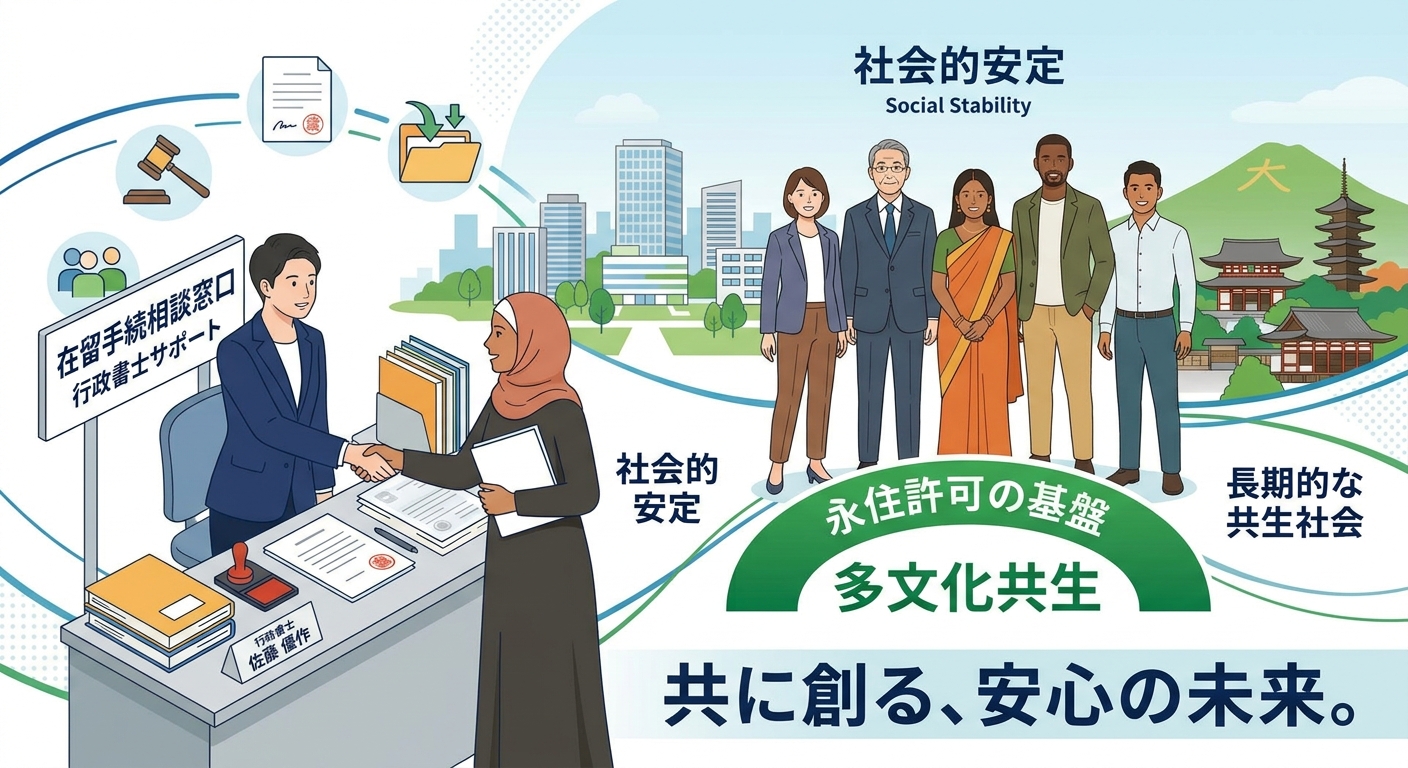
Regarding the revision of the guidelines for permanent residence permission, it is often discussed from the perspective of the Ministry of Justice and immigration control as a "stricter management." However, the essential perspective does not stop there. This revision, particularly the explicit specification of Japanese language proficiency (equivalent to CEFR B1 / high JLPT N3 to around N2) and the requirement to understand Japanese social systems and rules, is one response to the sociological challenge of how to maintain and nurture the stability and sustainability of the community known as Japanese society.
We will decipher this revision from the perspective of coexistence with local communities, moving away from the mere context of "regulation."
1. A "common language" as infrastructure for an inclusive society
The granting of permanent residency means welcoming that person as a "member of society" for the rest of their life. Up until now, permanent residency screening has focused mainly on the "length of stay" and "economic independence (income and tax payment)," while language proficiency has not been explicitly stated.
However, "permanent residency" without the ability to communicate in the language will lead to isolation and friction within the local community in the long term.
- Guarantee of life in emergencies and disastersBeing able to correctly understand and act upon evacuation orders, disaster prevention information, and important notices from local governments is essential not only for one's own safety, but also for maintaining the crime prevention and disaster preparedness level of the entire community.
- Prevention of mutual distrustCommunication gaps caused by language barriers tend to blow minor daily frictions, such as garbage disposal or noise, out of proportion into "conflicts rooted in cultural and national differences."
We need to reframe Japanese language proficiency not merely as a screening tool, but as "infrastructure" deeply rooted in society that enables people to live safely and peacefully.
2. Transition from "dependency" to "two-way participation"
To ensure the sustainability of a multicultural society, a framework is required in which foreign residents do not merely remain unilateral "beneficiaries of administrative services," but can participate as independent "contributors to society."
| Perspective | Previous challenges | Changes brought about by making Japanese language proficiency and institutional understanding requirements |
| Administrative Procedures and Daily Life | tends to rely on excessive support from interpreters and government administration | I can independently complete administrative and contractual procedures, which increases my self-reliance. |
| Labor and Career | They tend to remain in low-skilled labor due to the language barrier. | It enables social advancement and improves financial stability |
| local autonomy | Isolated from community activities such as neighborhood associations and PTAs | It becomes possible to communicate, and you can participate in the management side of the community. |
Having Japanese as a common language allows residents to shift their position from being "protected subjects" to "equal partners supporting the local community."
3. Passing on to the next generation and stabilization of the social structure
The increase in permanent residents means that their children will grow up in Japanese society. The fact that the current revision proposal lists "children's education" and "understanding of systems and rules" as evaluation items holds extremely great significance when considering the sustainability of society.
If the linguistic environment at home or the parents' understanding of society is inadequate, there is a high risk that children may fall into double-limitedness (a state where neither their mother tongue nor Japanese is proficient) or miss out on educational opportunities. This can directly lead to the risk of a future cycle of poverty and social division.
For the parent generation to possess a daily, social-level proficiency in Japanese is a prerequisite for the next generation to grow up healthily in Japanese society and become the bearers of the future.
What we should think about for the sustainability of society
Whether this guideline revision is seen as "strengthening barriers against foreigners" or as "foundational preparation for sustainable coexistence" will dramatically change Japan's future vision.
Rather than simply tightening standards and turning people away, we are challenged to pair conditions with the provision—by society as a whole—of educational environments and support infrastructure that enable those who wish to live long-term in Japan to learn the language and systems smoothly.
The tightening of permanent residency requirements should not be seen as a way for Japan to "exclude different cultures," but rather positioned as "a process in which both the receiving side and the resident side share the readiness and preparation to live together and maintain society together."