I will reply to you within 24 hours/.
[2026 Latest] Stricter Permanent Residency for Foreigners? Explaining Changes to Guidelines, Annual Income, and Pension Requirements
For foreign nationals living in Japan, the "permanent resident" status, which frees them from the hassle of visa renewal procedures and allows them to gain social credibility and easier access to housing loans, is a major milestone in their careers and lives.
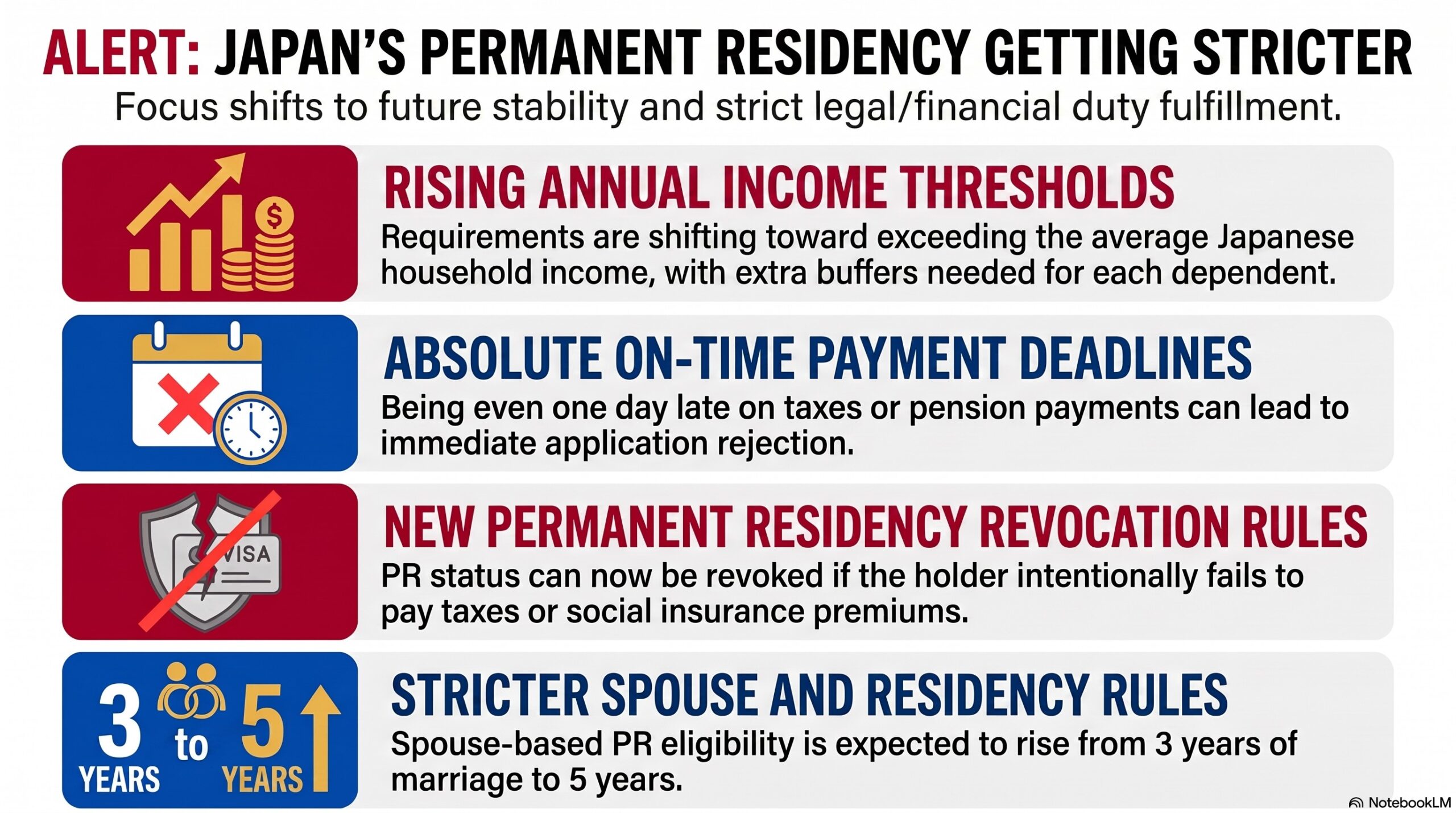
However, we are now at a turning point where policies are shifting to significantly raise the requirements for "permanent residency."
In addition to the introduction of the "Permanent Residence Permit Revocation System" for non-compliance with public duties due to the amendment of the Immigration Control Act,Major Revision Policy for "Guidelines on Permanent Resident Status"and showing that the practical hurdles have increased, from annual income and pension to Japanese language proficiency and period of stay.
This article clearly explains the key points of the latest guideline revisions and the details to watch out for in the examination process (pensions, taxes, and income blind spots).
Key points of this article
- Guidelines Update: Annual income standard raised to "above Japanese average annual income," Japanese language proficiency and understanding of the system also to become mandatory.
- Thorough fulfillment of public duties: For pensions and taxes, it is an absolute requirement not only to have “no outstanding payments” but also to “strictly adhere to payment deadlines.”
- Improvement of cancellation regulations: Even after obtaining it, the permanent resident status may be revoked due to intentional arrears, etc.
TOC
1. What changes with the guideline revision? 4 main changes
The proposed revision of the "Guidelines for Permanent Residency" being considered by the Immigration Services Agency of Japan presents requirements that go a step further than the previous examination and operation.
* The income requirement will be applied retroactively to April 2026.
| Review items | Traditional Guidelines/Operations | Revised new standards and policies |
| Annual income requirement | An annual income of around 3 million yen is a rough benchmark. | Average annual income of Japanese householdsto exceed |
| Pension requirements | No history of unpaid or overdue payments | Estimated future benefitEvaluate (cover any shortfall with savings, etc.) |
| Language and Institutional Understanding | No clear standard requirements | Japanese Language Proficiency(Suitable for a wide range of everyday situations)Understanding Japanese Systems |
| Spousal exception | Married for 3 years and resided in Japan for 1 year or more | Married for 5 years and lived in Japan for 3 years or more.Policy to raise to |
Until now, the focus has been primarily on past performance—specifically, whether there have been any past instances of delinquency—but going forward, future stability and economic foundation—namely, whether the applicant can live independently in Japanese society for the long term—will be rigorously assessed.
2. The Pitfalls of "Strictly Adhering to Deadlines" for Pensions, Taxes, and Social Insurance
The most common reason for rejection during the review process is the status of payments of public obligations. Here, the focus is not on whether the payment was made, but rather on whether it was made on time (within the payment deadline), and this is scrutinized very closely.
① Even a single day's delay could result in your application being denied
Even if you forget to pay and pay after receiving a reminder, or if there is a delay of a few days due to a failed bank transfer, it will be considered a "failure to meet the payment deadline" and may result in denial.
② Pension transfer omission (Employees' Pension ⇔ National Pension)
If you experience a temporary period of non-payment due to delays in procedures when changing jobs or becoming independent, even if you make retroactive payments later, it will not be considered "on-time payment history."
Spouse's payment status is also covered.
Even if the applicant personally pays their premiums properly through payroll deduction (special collection), any delinquency in their spouse’s National Pension or health insurance premiums will result in the application being denied for the household as a whole.
3. The Complex Relationship Between Income Requirements and "Number of Dependents/Assets"
In addition to the "average annual income of Japanese households" border line introduced by the new standard, "number of dependents" will practically raise the required annual income amount.
- Dependent credit increase If you support your parents, spouse, or children in your home country, you will need an additional annual income of approximately 300,000 to 500,000 yen per dependent.
- The headwind against excessive tax avoidance: If you previously claimed many relatives in your home country as dependents for tax-saving purposes, there is a risk that removing them and filing an amended tax return just before applying will be considered an "unnatural adjustment made immediately before."
- Supplementary by savings and financial assets Even if your expected pension benefits or individual annual income do not meet the criteria, a system will be introduced where sufficient savings and financial assets will be evaluated and supplemented comprehensively.
4. Period of Stay Requirements and the "Revocation Clause After Acquisition"
As a prerequisite for applying for permanent residency, it is now the general rule that you must have resided in Japan for the maximum legal period allowed under your current visa status (e.g., 5 years).
Also, recent amendments to the Immigration Control Act have established a provision stating that "permanent residency status can be revoked if taxes and social insurance premiums are deliberately unpaid after obtaining permanent residency."
This clearly changes permanent residency from a "right that lasts once obtained" to a "status maintained by continuously adhering to the rules of Japanese society."
5. Clarification and Stricter Enforcement of Japanese Language Proficiency Requirements
In the proposed revision of these guidelines, clear new specific criteria for the national interest requirement have beenJapanese language proficiency requirementIt was indicated that a policy will be established..
- Required level:
- CEFR (Common European Framework of Reference for Languages) for Japanese Language Education: Equivalent to B1 (independent language user)
- Background and Purpose: Because permanent residents have "the most stable legal status with no restrictions on activities or duration of stay, and are expected to spend their lives in Japan," their Japanese language proficiency is carefully examined to ensure they can reliably communicate in the local community, participate in society, and understand laws and rules.
Summary: Prepare in advance for a successful permanent residency application
The tightening of permanent residency requirements aims to maintain a fair social security system and to optimize regulations. However, to avoid having your path to permanent residency blocked by "inadvertent delays" caused by unfamiliarity with Japan's complex procedures and tax system, thorough preparation and an accurate assessment of your current situation are essential.
For those considering permanent residency, it is recommended to manage "tax and pension payment deadlines" starting 1-2 years before applying..I strongly recommend strategically organizing your dependency situation.