Hey You Aiming for Study in Japan! Tips to Avoid Stumbling on “Study” Residence Status Application (Latest 2026 Edition)
Hey there! All you young folks living abroad, thinking about studying in Japan? Walking around campus during cherry blossom season, grabbing ramen with friends—it sounds like a dream, right? But the first step to studying abroad is applying for your “residence status.” If that doesn’t go through, you can’t even enter Japan. Today, based on the official Ministry of Justice website and the latest guidelines (as of January 2026), I’ve summed up the key points to note for the “Study” residence status application in a quick, easy way for folks like you. It might sound complicated, but if you prepare step by step, you’ll be fine. Check it out early to avoid any trouble!
1. Get the Basics Down: Who’s Eligible?
The “Study” residence status is for attending universities (including junior colleges and graduate schools), vocational schools, high schools, junior high schools, elementary schools, technical colleges, or certified Japanese language institutions in Japan. Grad schools and language schools are okay too. The stay period can be up to about 5 years, decided on a case-by-case basis. If you’re coming from overseas, start with applying for a “Certificate of Eligibility” (COE). This acts kind of like a visa.
Update Points (2026): For university entrants from April 2030 (Reiwa 12) onward, new confirmation documents might be needed. As of 2026, the old rules are still the main ones, but keep future changes in mind. Also check if your school is certified as a “proper school” (Class I/II)!
Tips for Young Folks: Once your school is decided, jump on the application prep right away. Some schools offer support, so ask them! If you’re under 16, you’re exempt from submitting a photo.
2. Preparing Required Documents: Forget These and You’re Out!
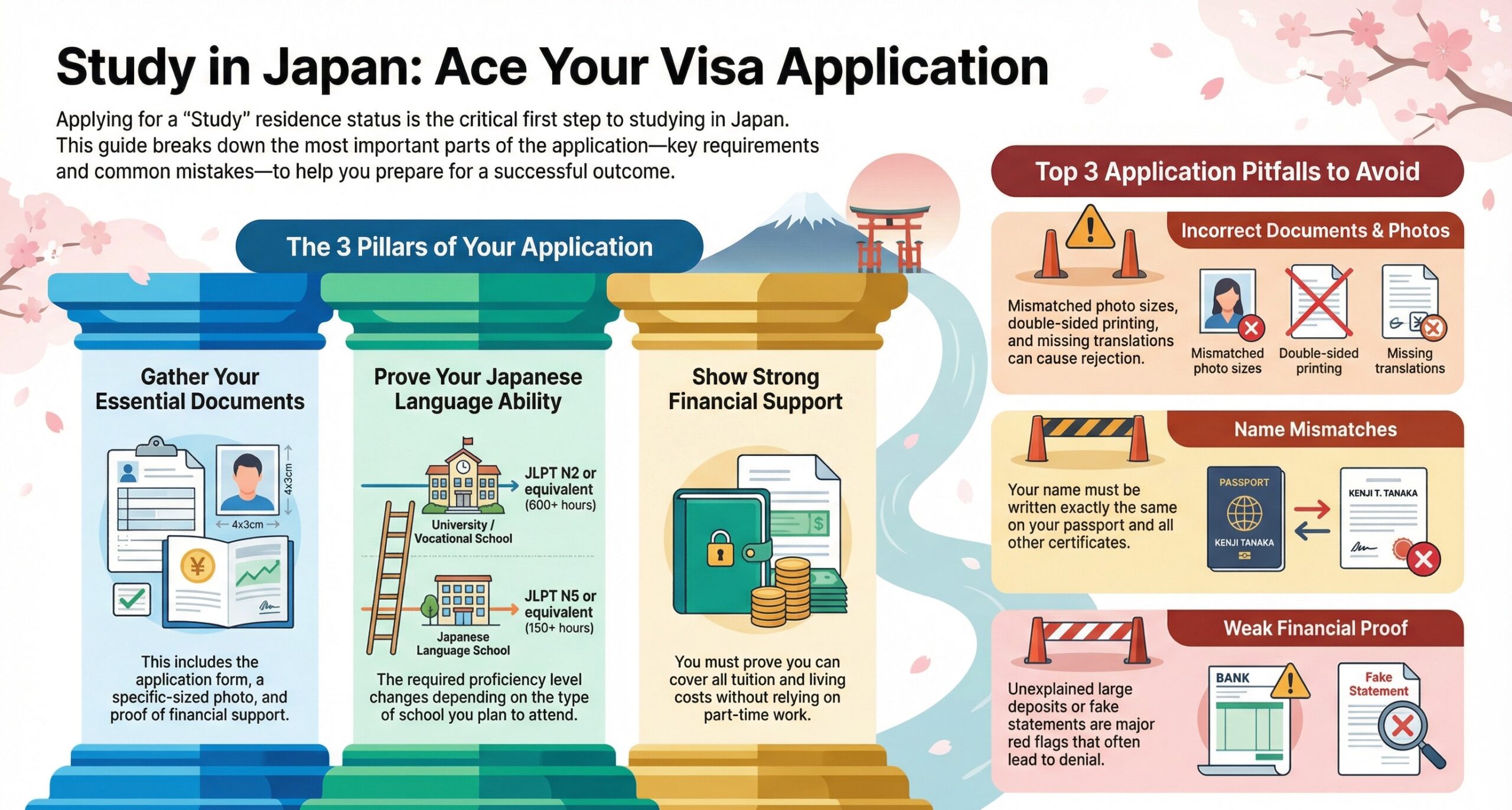
You can download the application forms from the Ministry of Justice site. Print on A4 size, single-sided (no double-sided). Photos must meet specs (4cm tall x 3cm wide, no hat, plain background, taken within 3 months). For foreign-language docs, attach Japanese translations, and Japanese-issued certificates must be within 3 months of issuance.
- Main Documents (For New Applications):
- Application form and photo (stick to the specs!).
- Return envelope (with stamps for registered mail).
- Copy of passport (watch for name mismatches).
- School-specific add-ons: Expense coverage statement (proof of how you’ll cover living costs, PDF format), scholarship proofs, separate sheets (various confirmation forms, Excel format).
- Documents proving Japanese language ability (details below).
- Submitted documents checklist (arrange in number order and circle “Yes/No”).
Additional Info (From PDF/Guidelines): Docs won’t be returned after submission, so request returns for originals if needed. If you can’t submit something, explain why + provide alternatives. Required docs vary by your home country (check the separate table). They might ask for extras during review, so be flexible.
Tips for Young Folks: If you’re abroad, double-check that your passport name matches the certificates! Mismatches can delay things. If planning on scholarships, gather proof early. Loan-type scholarships need extra docs.
3. Proving Japanese Language Ability: It Varies by School!
To study in Japan, Japanese skills are key. Requirements change based on the institution, so check carefully!
- Universities, Junior Colleges, Grad Schools, Technical Colleges: Need proof of N2 equivalent (600+ hours). Japanese Language Proficiency Test (JLPT) N2 or higher, or Examination for Japanese University Admission (EJU) Japanese section (reading/listening total 200+ points), or BJT Business Japanese 400+ points.
- Vocational/Miscellaneous Schools: Proof of 1+ year at a Ministry-designated Japanese language institution, or exam proof (same as universities), or 1+ year at a Japanese school (per School Education Law, excluding kindergarten).
- Japanese Language Institutions, Prep Courses, University Japanese Prep: A1 equivalent (150+ hours). JLPT N5+, BJT 300+, J.TEST F grade+, etc.—various exams okay. Exempt if you graduated from a foreign higher ed institution (submit grad cert).
- High/Junior High/Elementary Schools: For entries before March 2025 (Reiwa 7), old docs are fine.
Exemption Cases (From PDF): For university prep to main course advancement, if tuition/dorm fees are fully covered (no repayment), recommended by home uni, expected to contribute internationally after return, etc.—conditions met, language requirements waived. Needs written agreement, and only for proper enrollment-managed schools.
Tips for Young Folks: If Japanese is tough, start with a certified language school. Prepare certificates for immigration submission. Common pitfall: Insufficient ability might get you labeled as “unable to receive education.”
4. Expense Coverage Ability: Money Proof is Super Important!
To have a stable life studying in Japan, solid financial planning is a must. The Immigration Services Agency focuses on this to prevent post-entry hardships.
- Main Docs: Bank balance certs (from gov-approved banks), fund formation history (statements, passbook copies, income proofs), for hard-to-remit countries, explain asset export method.
- Guidelines: Refer to Japan Student Services Org’s survey. Part-time work limited to 28 hours/week (about 80k-110k yen/month pre-tax), can’t cover all tuition/living with it. Fakes or temp large deposits hurt future apps.
- Additional Info (From Guide Images): Prioritize no-repay scholarships. For family support, include relation proof and background. Living costs vary by area, but aim for 100k+ yen/month in Tokyo.
Tips for Young Folks: Part-time is okay, but not at the expense of studies. Follow minimum wage laws. Short funds often lead to rejection, so make a realistic plan.
5. Application Types and Timing: Choose Based on Your Situation
- New Entry (From Overseas): Apply for COE via Japanese embassy/consulate.
- Status Change: If in Japan but switching to study. If not active on current status, it might get canceled! Apply ASAP.
- Extension: For continuing studies, apply early for renewal. Need stay expense declaration.
- Acquisition: If born in Japan etc. and need status.
Update Points (2026): Apps before Dec 2024 (Reiwa 6) can use old forms, but latest recommended. Prep for potential extra doc requests during review.
6. Common Mistakes and How to Avoid Them: Smooth Sailing Ahead!
- Photo Mistakes: Wrong size/specs mean resubmit. Check specs ahead! (Emphasized in guide images).
- Doc Order/Issues: Not numbering the list causes mess. No foreign translations or expired docs are NG.
- Proxy Application: If you can’t do it yourself, use school staff or family. Family needs family register, employees need ID.
- Name Mismatches: Passport vs. docs differ? Delays. Attach copies.
- Fund-Related: Weak balance proofs or fake suspicions lead to denial. Use real docs.
- Inquiry Help: If stuck, call the Foreign Residents Info Center (TEL: 0570-013904, from abroad 03-5796-7112). English available.
- Post-Entry Reports: After entry, report address/school changes. Skipping means penalties.
- Additional Mistake Examples (From Guide Images): Form blanks, photo backgrounds, double-sided prints, missing scholarship proofs. Uni hopefuls failing on language skills.
Advice for Young Folks: Studying abroad is exciting, but apps are tedious work. Share with friends or check online communities for stories to stay motivated. Don’t rush—get docs ready a month ahead. Mistakes can delay your start date.
Summary: Make Your Study Abroad Dream Come True!
Studying in Japan is a chance to change your future, from cultural experiences to career boosts. The residence status app has tons of rules, but follow these tips and you’re good. Bookmark the Ministry of Justice site for latest info! If in trouble, consult your school or experts. Cheering for your adventure—go for it!
 日本語
日本語  English
  繁體中文
繁體中文