I will reply to you within 24 hours/.
Implications of the Statement by the Chairman of the Japan Federation of Gyoseishoshi Lawyers' Associations, "Efforts in Connection with the Revision of the Criteria for Permission of "Management and Administration" Status of Residence
Business Manager Visa
Management visa
paralegal qualified to prepare legal documents on administrative matters, e.g. immigration

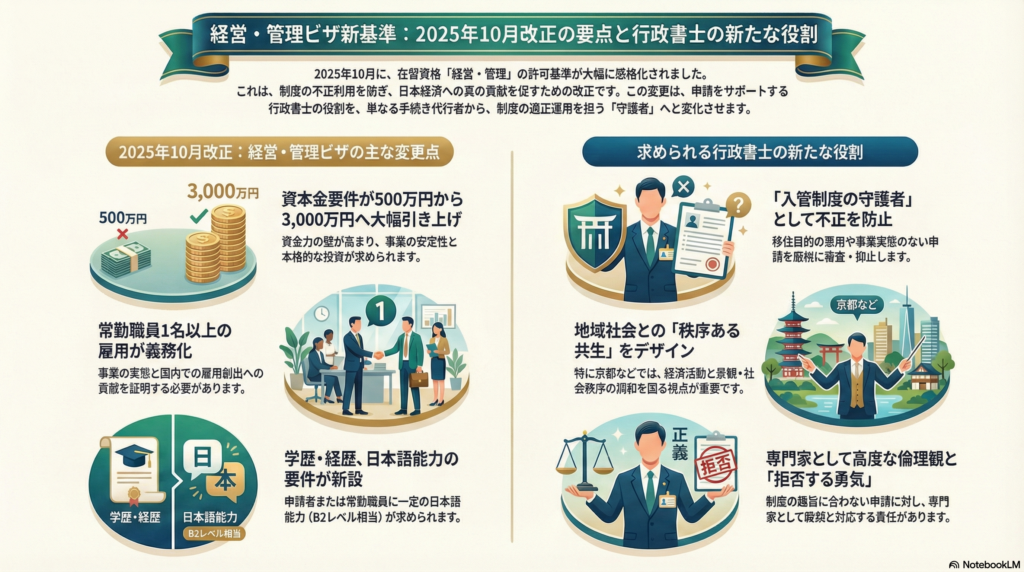
The Chairman's Statement of the Japan Federation of Administrative Scrivener's Associations (hereafter referred to as "the Federation"), released on December 4, 2025, is an important document that redefines the role of administrative scrivener against the backdrop of the revision of the criteria for granting "Management and Administration" status of residence (effective October 16, 2025).
TOC
Chairman's Discussion Summary
The core of the discourse is that, with the implementation of the revised criteria (increase in the amount of capital and investment from 5 million yen to 30 million yen, new requirements for educational background and experience, obligation to hire at least one full-time employee, and Japanese language proficiency requirements for applicants or full-time employees), administrative scriveners must ensure compliance with the law and uphold the original purpose of the status of residence (contribution to the development of Japanese economy and society through foreign management activities). The purpose is to ensure compliance with laws and regulations and to protect the original purpose of the status of residence (contribution to the development of the Japanese economy and society through the business activities of foreigners). The Federation emphasizes the role of administrative scriveners in preventing and deterring abusive use of the status of residence (misuse as a means of immigration or application without an actual business presence) through the preparation of applications for issuance of certificates of eligibility, which is their business. In addition, it cites its more than 30 years of experience in the "application agency system," positions administrative scriveners as "guardians of the immigration control system," and expresses its determination to contribute to the "realization of an orderly and harmonious society" with foreign residents.
This discourse cites the background of the revision (correction of loose standards compared to other countries, prevention of fraudulent use, and deterrence of applications without actual business) and calls on administrative scriveners to ensure compliance with the law and contribute to its proper application. What it suggests is not merely a regulatory response, but an "ethical and social evolution" of the administrative scrivener industry: improving the quality of immigration policy through fraud prevention and building a society in harmony with foreigners.
General Interpretation
Background and ObjectivesThe revision is intended to correct the fact that the existing standards were more lenient than those of other countries, and to reduce cases of fraud in the examination process (e.g., paper companies, etc.). The discussion considers this as an "opportunity" to promote proper operation by taking advantage of the expertise of administrative scriveners.
Key Points of Argument:
- Ensure compliance with laws and regulations: As professionals who prepare applications, administrative scriveners should avoid encouraging fraud and strengthen verification of the actual business situation.
- Social Contribution Perspective: Reaffirms the economic contribution objective of the qualification and declares its contribution to building a symbiotic society.
Implications for the Administrative Scrivener Industry: Encourage ethics education and skill development of administrative scriveners in advance of the increased complexity of applications due to the revision. The result has the potential to improve confidence in the industry and expand business.
Interpretation from the perspective of an administrative scrivener involved in public administration for 35 years in Kyoto Prefecture
Impact of the Amendments on Field Practice
While the general interpretation emphasizes fraud prevention, in Kyoto practice, it directly hits foreign entrepreneurs who are entering many businesses that aim to combine traditional technology with modern innovation. In Kyoto, where foreign entrepreneurship has been active with the traditional 5 million yen capital, the 30 million yen requirement will likely raise the "financial strength barrier" and push the risk of rejection up 30-501 TP3T.
Kyoto Prefecture's support for "start-up visas" (Kyoto Overseas Business Center) was gradual before the revision, but "verification of actual conditions" (deeper market analysis and profit forecasting) of business plans is key from now on. The "proper operation" assertion of the discourse imposes the role of "policy advocate" on administrative scriveners.
In Kyoto, where foreign entrepreneurship is active, there were concerns about "landscape overdevelopment" and "disturbance of social order" under the loose standards before the revision. We see the discourse as suggesting a "redesign of symbiosis that takes advantage of local characteristics. As a World Heritage city, Kyoto is a proposition to strike a balance between traditional landscape and modern business.
Ethical Responsibilities of Administrative Lawyers
The "long-awaited and well-known" language of the Discourse requires that administrative officers have the "courage of their refusal". The Discourse serves as an "ethical compass" to prevent risk.
Linkage with Kyoto's public policy
The closing of the discourse, "Realization of an Orderly and Symbiotic Society," is particularly resonant in the context of Kyoto. Kyoto Prefecture has the potential to support the local economy through multicultural policies and foreign entrepreneurship. The discourse can be interpreted as a shift of Gyoseishoshi Lawyer from "on-site executor of policies" to "advocacy partner".
Landscape Protection Perspectives
The discourse eliminates the risk of landscape destruction through administrative verification of the actual business situation. The suggestion is "immigration policy with protection priority" - preventing unplanned development while utilizing foreign entrepreneurship to stimulate the economy.
Protection of Social Order
Social order (guaranteeing local residents' right to life) is the key to multicultural coexistence in Kyoto. The discourse imposes the role of "guardian of order" on the administrative scrivener. Entrepreneurial support will promote local employment (full-time obligation) and strengthen social inclusion. Suggestion is Kyoto's "Harmony Model" - use the revision as an opportunity to build a sustainable, symbiotic society that does not damage the landscape and order.
Potential Implications: A turning point to face as the culmination of a career.
The revision is a test of "sustainability". The future orientation of the discourse ("We will contribute") reminds those of us who have walked with the administration for many years, such as myself, of our mission to pass on the "resilience of policy adaptation" to future generations. As a result, the public reputation of the administrative industry as a whole will be enhanced.
 日本語
日本語  English
  简体中文
简体中文  Français
  Español
  Tiếng Việt
  한국어
한국어