Navigating the Student Visa: A Guide for Vocational School Applicants in Japan
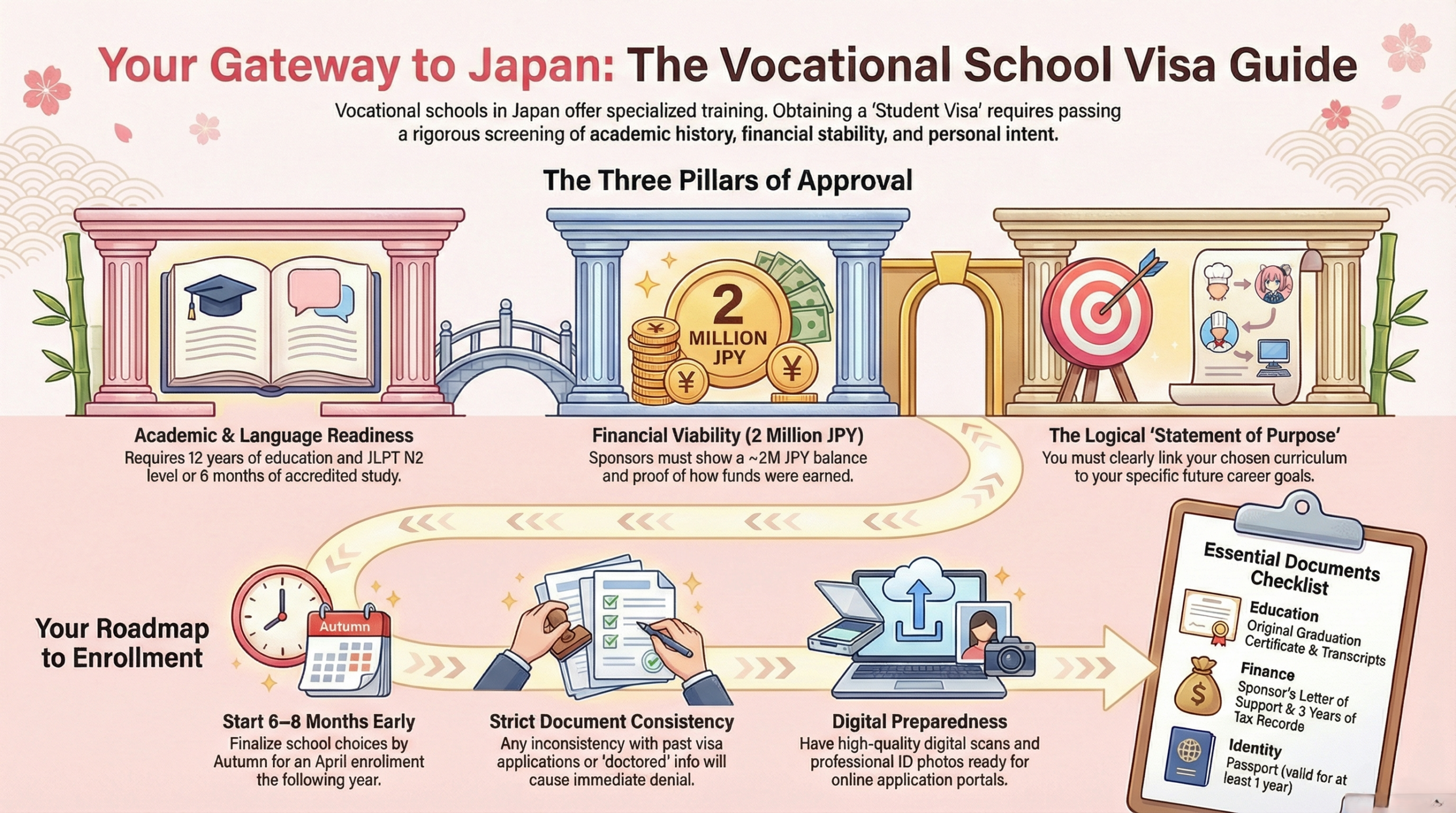
While universities focus on academic research, Japanese vocational schools specialize in practical fields like Anime, IT, Design, Gastronomy, and Caregiving. Because these courses are highly specialized, the Immigration Bureau scrutinizes your intent to study and your post-graduation plans more closely.
1. The Application Roadmap
The process is a relay race between you, the school, and the Japanese Immigration Bureau.
- Pro-tip: Start your preparation 6 to 8 months before your intake. For an April 2026 enrollment, you should be finalizing your school choice by Autumn 2025.
2. Three Pillars of a Successful Application
To grant a visa, Immigration officers look for “The Three Pillars.” If one is weak, the visa may be denied.
I. Academic Background & Language Proficiency
- 12 Years of Education: You must have completed high school (or equivalent) in your home country.
- The Japanese Requirement: Since vocational courses are taught in Japanese, you generally need to meet one of the following:
- JLPT N2 level or higher.
- A score of 200+ on the EJU (Japanese as a Foreign Language).
- At least 6 months (ideally 1 year) of study at a Japanese language institution accredited by the Ministry of Justice.
II. Financial Viability (Financial Support)
You must prove you can afford tuition and living costs without relying on part-time work.
- Bank Balance: A common benchmark is showing a balance of approximately 2 million JPY in the sponsor’s (usually a parent’s) account.
- Consistency: Immigration may ask for “Proof of Fund Formation”—documents showing how that money was earned over time (e.g., pay slips or tax returns).
III. The “Statement of Purpose”
This is the most critical document. You must clearly explain:
- Why you chose Japan over your home country.
- How the specific curriculum of the school connects to your future career.
- Logical Consistency: Your past experience, current study, and future goals must form a straight line.
3. Key Advice for 2026 Applicants
With stricter oversight on residency status, pay attention to these modern requirements:
- Strict Honesty: Never submit “doctored” documents or inconsistent information. If your birth date or family history differs from a previous visa application, it will trigger an immediate red flag.
- Digital Preparedness: Many schools now use online application portals. Ensure you have high-quality digital scans of your transcripts and a professional digital ID photo ready.
- The “Specific Skilled Worker” Path: If your goal is to work in Japan immediately after, check if your chosen school offers support for the “Specified Skilled Worker” (Tokutei Ginou) visa path, which is becoming a popular alternative.
Essential Checklist for Success
| Category | Requirement |
| Education | Original Graduation Certificate and Transcripts |
| Japanese | JLPT Certificate or Certificate of Enrollment from a Language School |
| Finance | Sponsor’s Letter of Support and 3 years of Income/Tax Records |
| Identity | Passport valid for at least the first year of your stay |
 日本語
日本語  English
  繁體中文
繁體中文