I will reply to you within 24 hours/.
Passing Kyoto's Culture to the Next Generation. Why we should nurture bearers of tradition with "specified skills" now, instead of waiting for "training and employment".
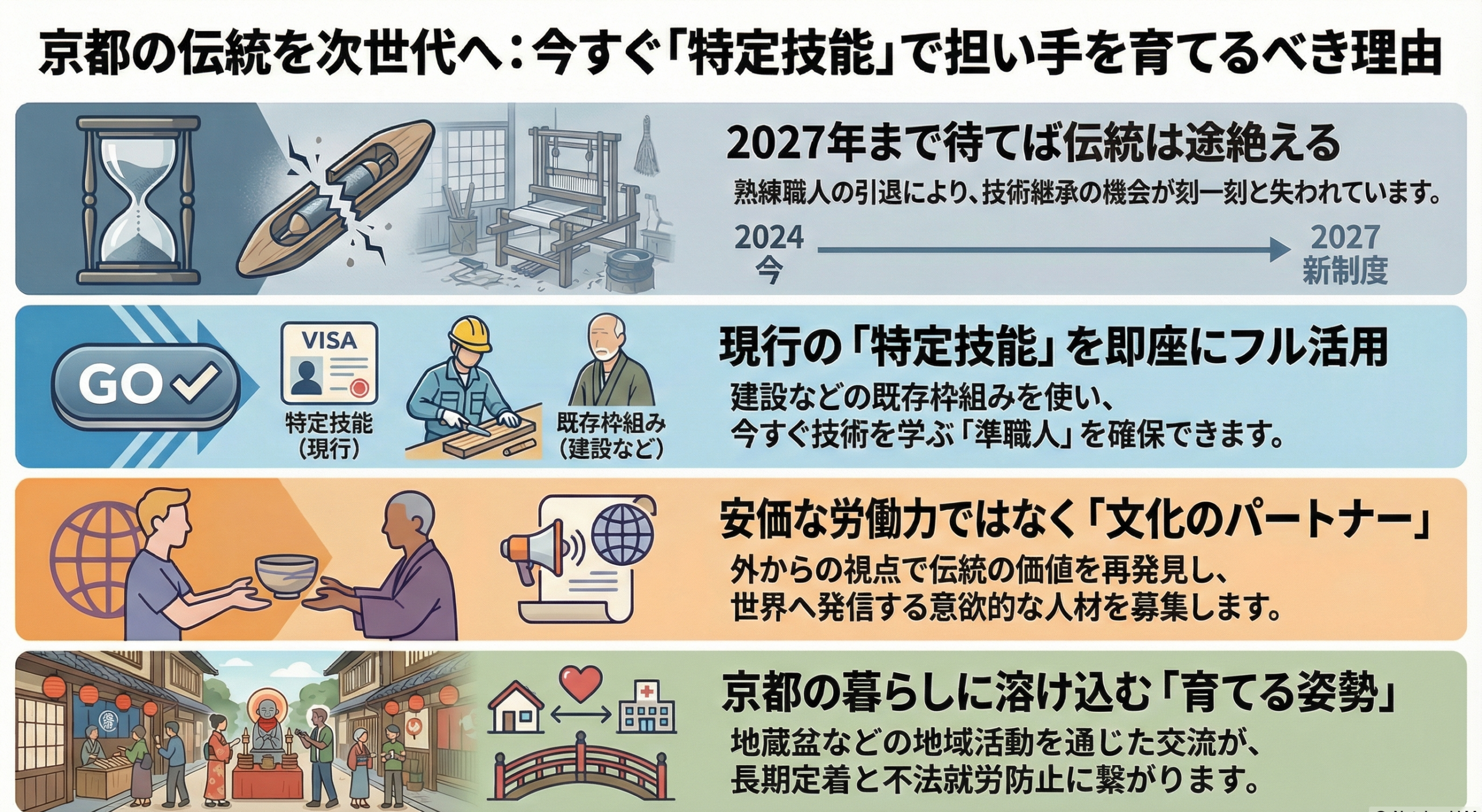
- If we wait for "grow-up employment," the tradition will cease to exist.
While there is growing interest in the "Nurtured Work System" to be launched by 2027, the shortage of labor in the field in Kyoto, especially in the repair of Kyomachiya houses and traditional industries, is a time-sensitive issue.
Current issue: While waiting for the new system to take effect, skilled craftsmen are retiring and opportunities to pass on their skills are being lost.
Solution: It is important to move now to secure these positions by fully utilizing the "specified skills" (e.g., construction) already established in the system and "technical, humanities, and international work" for university graduates.
- Kyoto's affinity for the expansion of "specific skills
Recently, the scope of specified skills has expanded to include the railroad field. How to apply this to the peripheral areas of traditional crafts and townhouse repair is where we can show our skills as international administrative scriveners.
Example: Training not as mere "workers" but as "quasi-craftsmen" who understand Japanese design and structure.
Advantages: With specific skills, instead of strict "transfer restrictions" as with technical training, a more flexible career path can be offered, making it easier to attract highly motivated personnel.
- Foreigners as "Bearers of Culture" in the Kyomachiya Project
Many foreigners have a deep respect for traditional Japanese architecture, as in the case of the "Kyomachiya Project" I am supporting, which recruits young people from North America.
Shift in perspective: They are not "cheap labor. They are "partners" who, with an outside perspective, will rediscover the value of Kyomachiya, which we take for granted, and transmit it to the world.
- Kyoto's pride" to welcome you as a member of the local community
As we operate our business in Kyoto, it is essential not only to have them work for us, but also to make sure that they are integrated into the Kyoto lifestyle through activities such as Jizo-bon and community cleanups.
Attitude: Transcend the language barrier, show your skills behind your back, and enjoy the culture together. This "nurturing attitude" will prevent illegal employment and lead to long-term settlement (the path to permanent residence).
 日本語
日本語  English
  简体中文
简体中文  Français
  Español
  Tiếng Việt
  한국어
한국어