I will reply to you within 24 hours/.
From Working Holiday to Cultural Activities Visa: A Guide to Staying in Japan and Mastering Traditional Culture
"My Working Holiday visa is coming to an end, but I want to stay in Japan and continue my training in traditional Japanese dance."
"I’ve fallen in love with pottery, and now I want to stay in Japan to learn the craft more seriously under a traditional master."
Many foreigners who come to Japan on a Working Holiday Visa fall in love with the country and inspire to dive deeper into its culture. However, the Working Holiday stay is generally limited to one year. To remain in Japan and dedicate yourself to these cultural pursuits after your visa expires...you must apply for a Change of Status of Residence to a 'Cultural Activities' visais required.
In this guide, we will break down the essential points and key requirements for transitioning from a Working Holiday to a Cultural Activities visa in an easy-to-understand way.
TOC
What exactly is a "cultural activities visa"?
The Cultural Activities visa is a status of residence for activities such as "academic or artistic activities without remuneration" or "activities to acquire specialized knowledge or skills in Japanese culture or traditional arts through research or instruction by a leader."
Specific common target activities
- Acquiring uniquely Japanese culture and arts Tea ceremony, flower arrangement, judo, karate, Japanese cuisine, bonsai, taiko drumming, kimono dressing, pottery, etc.
- Specialized research and artistic activities: Engage in academic research in collaboration with Japanese university professors, and conduct independent artistic creation activities (however, do not earn income from selling works, etc.).
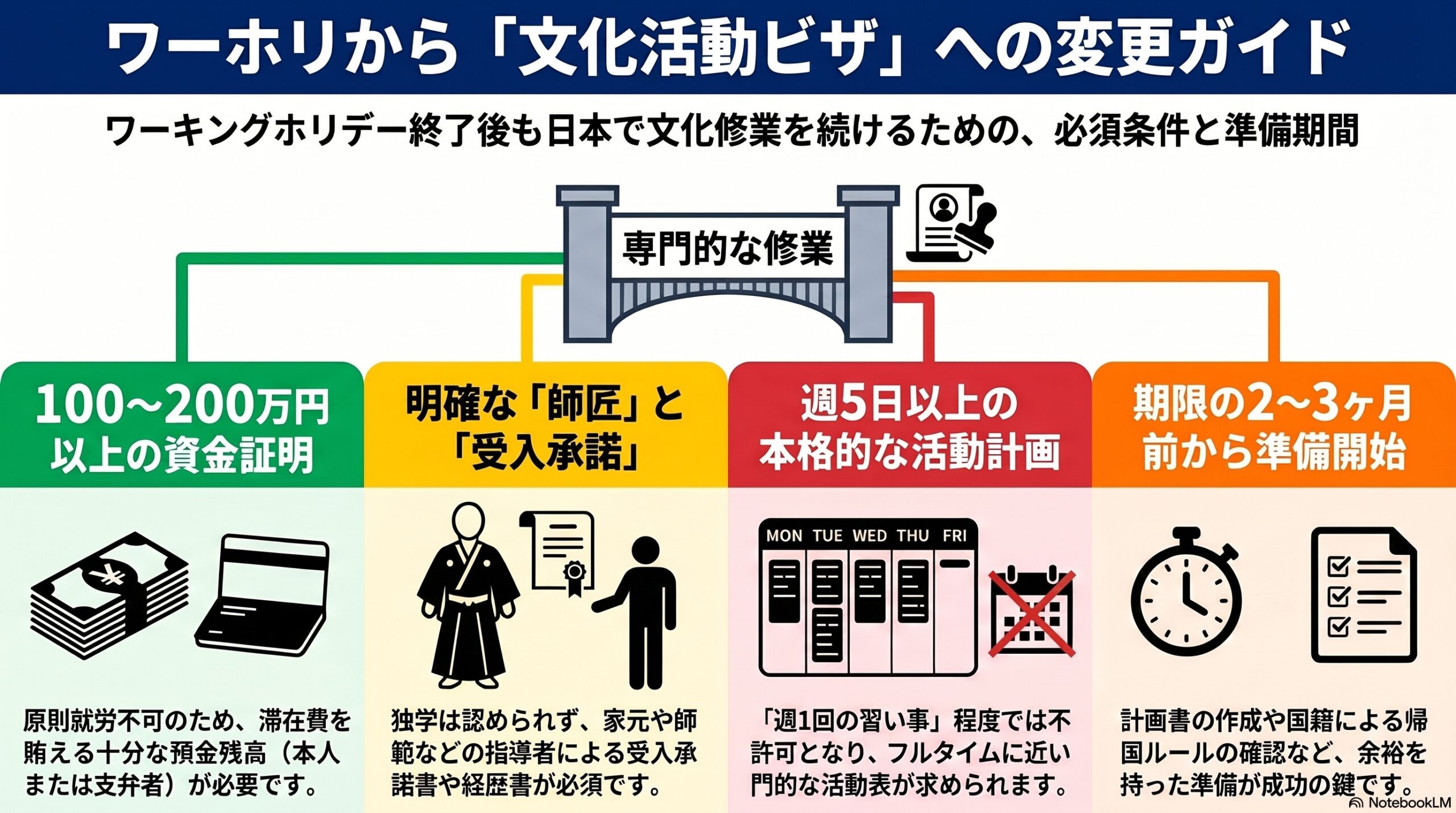
"3 Essential Conditions to Secure When Changing Your Working Holiday Visa"
When applying to change from a Working Holiday visa to a Cultural Activities visa, the Immigration Services Agency (Immigration Bureau) primarily checks the following three points very strictly:
1. [Most Important] Proof of Financial Means (the "Unable to Work" Barrier)
The cultural activities visaAs a general rule, working is not permitted.(While it may be possible to work part-time for up to 28 hours per week by obtaining permission for activities outside the scope of your visa status, financial plans based on this assumption will not be approved.)
So, enough to cover all your living expenses in Japan, such as tuition, rent, and foodSufficient funds (savings)orHaving a reliable financial supporter (such as a parent)I have to prove it.
Objective: Depending on the length of your stay (e.g., six months to one year), you will be required to submit proof of bank balance of at least 1 million to 2 million yen or more (in your name or the name of your financial supporter).
2. Clarity of the mentor (master) and the host institution
Self-study of Japanese culture is not permitted. It must be clear "who (or where) you are learning from."
- Traditional performing arts families, martial arts dojo masters, and specialized schools will be the "accepting organizations."
- To apply, you will need the instructor's resume and a document confirming their acceptance (letter of acceptance or contract).
3. Professionalism and Continuity of Activities
A visa will not be granted for attending a hobby class once a week. You need an objective professional activity plan (such as a weekly schedule) that demonstrates intensive training and research multiple days a week during weekday daytime hours, on a schedule close to full-time.
Pitfalls to watch out for in change requests
Depending on nationality, "returning to your home country once" may be the general rule.
Depending on the working holiday agreement (arrangements by country/region), some countries clearly state that "you must return to your home country once after the working holiday ends." (e.g., some countries like the UK, Ireland, and France).
In this case, "Change of Status of Residence" within Japan is generally not accepted, and there are cases where you need to return to your home country and then apply for a "Certificate of Eligibility (COE)." Therefore, it is necessary to check the agreement details of your home country in advance.
② Consistency with "Work Experience" during Working Holiday
If someone who was working full-time at a restaurant or similar establishment during their working holiday suddenly applies to "dedicate themselves to the tea ceremony starting tomorrow," immigration authorities might suspect, "Is this a cover (sham) to illegally stay in Japan and continue working?" The persuasiveness of your "statement of reasons," which demonstrates actual involvement in that cultural activity from your working holiday period and explains why it is necessary now, will be crucial.
Key documents required for application (examples)
The following documents are generally required for a change request.
| classification | Examples of necessary documents |
| What the applicant needs to prepare | Application for Change of Status of Residence Face photo Passport and Residence Card Documents proving your stay expenses (e.g., bank statement) Statement of Purpose (Reason for wanting to study in Japan) |
| Items to be prepared by the accepting organization and supervisor | Acceptance Letter (or Agreement) ・Instructor's resume and materials showing their achievements (brochures, etc.) Specific Training/Acquisition Plan (Weekly Schedule) |
Summary: Thorough preparation is the key to success.
Changing from a Working Holiday visa to a cultural activities visa is not as simple as just submitting documents and getting approved. This is especially true for "proof of funds."andThe seriousness of the activity (schedule) is strictly reviewed.
My working holiday visa is expiring.2 to 3 months agoIt's important to start preparing and carefully develop an activity plan with your host mentor and school. If you have concerns about document preparation or confirming requirements, we recommend consulting a specialist, such as an administrative scrivener who specializes in foreign nationals.
Let's approach the application with thorough preparation as the first step to spreading Japan's wonderful culture worldwide!
 日本語
日本語  English