
[Latest for 2026] Thorough explanation of the benefits and requirements for the Highly Specialized Visa! The shortest route to permanent residence and tips for calculating points.
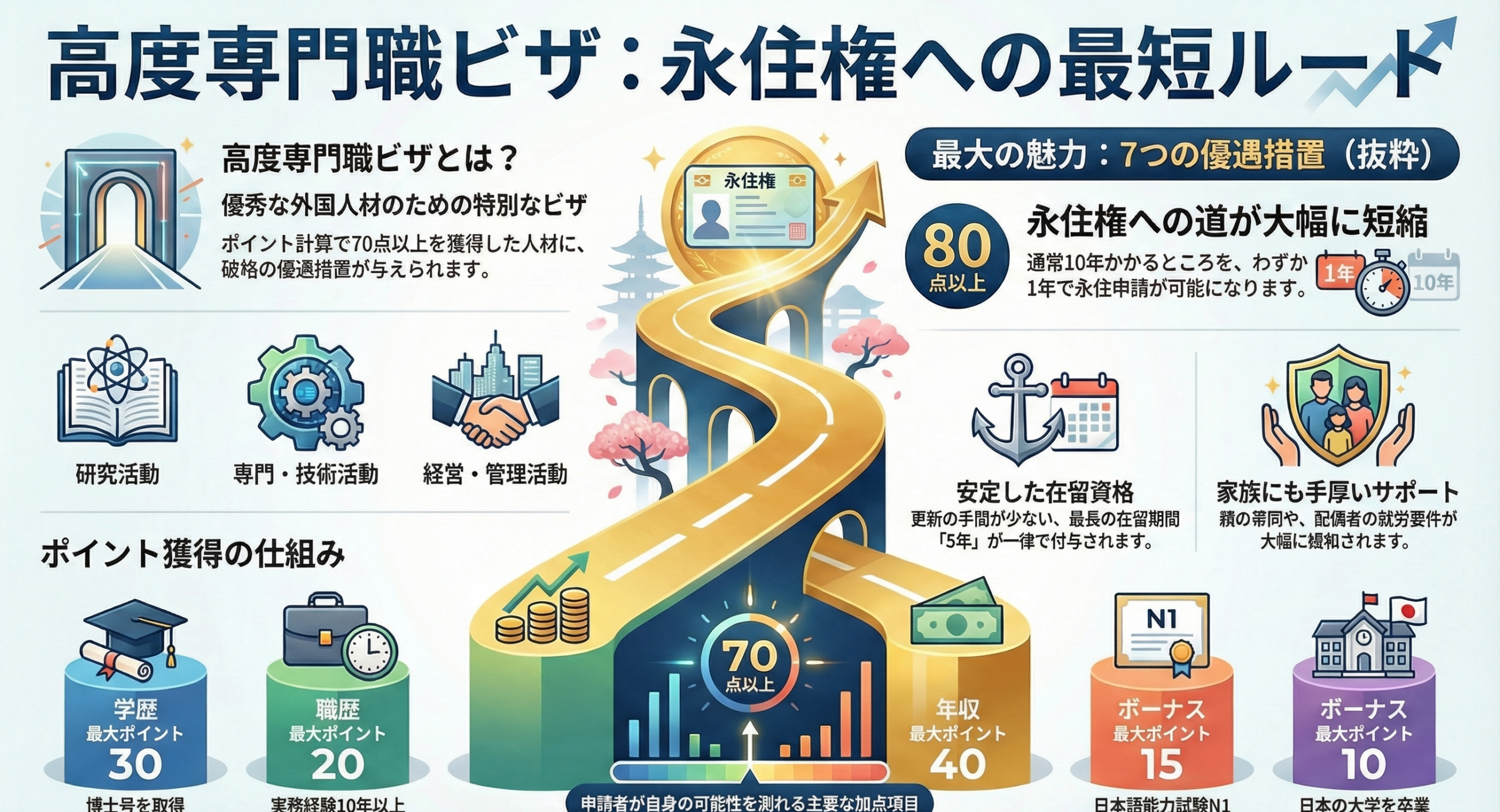
One of the most attractive residence statuses for talented foreign human resources working in Japan is the "advanced professional visa. Compared to other general work visas such as the "Technical/Humanities/International Services" visa, the "Highly Specialized Worker Visa" offers unparalleled preferential treatment, including a drastically reduced period of time until permanent residence is granted.
In this article, we will explain the advantages of obtaining an advanced professional visa, how the point calculation works, and what to keep in mind when applying, based on the latest information as of 2026, in an easy-to-understand manner from an expert's perspective.
1. what is a highly specialized visa?
The Highly Specialized Worker Visa is a system that gives preferential treatment to "highly skilled foreign human resources" who contribute to Japan's economic growth, based on an evaluation based on a point system. There are three major categories of activities as follows
- Advanced Academic Research Activities (Advanced Professional 1, a): University professors, researchers, etc.
- Highly specialized and technical activities (Highly specialized 1 (b))Engineers, marketers, professionals, etc.
- Advanced Management and Administrative Activities (Advanced Professional 1, c): Managers and executives of companies, etc.
2. 7 major advantages of obtaining a highly specialized visa
The main reason why this visa is chosen is the "preferential treatment" not found in other visas.
- Significant relaxation of permanent residence permit requirements: where normally 10 years of residency is required, it will now be possible to apply for permanent residence after 3 years for those with 70 points or more, and after only 1 year for those with 80 points or more.
- Granting a uniform period of stay of "5 years": reduces the hassle of renewal and increases stability in life.
- Parents can be invited to Japan (with certain conditions): If the purpose is to care for a child under 7 years of age or to assist during pregnancy, the parent of the applicant or his/her spouse can be invited to Japan.
- Relaxed restrictions on spouses' employment: Spouses can work full-time in "education" and "technical, humanities, or international work" jobs even if they do not meet the education and work experience requirements.
- Bringing a domestic servant: If certain annual income requirements are met, a domestic servant employed in the home country can be brought.
- Permission to engage in multiple activities of residence: In addition to the original activity, it is possible to manage a related business.
- Priority processing of immigration and visa status: Screening is expedited compared to other visas.
3.[Important] Point Calculation Mechanism and Passing Line
To obtain an advanced professional visa, the applicant must score at least "70" on the points table.
| Item | Examples of additions |
| academic background | PhD (30 points), Master's degree (20 points), MBA (with additional points) |
| work experience | 10 or more years of work experience (20 points), 7 or more years (15 points), etc. |
| annual income | Up to 40 points depending on the balance between age and annual income (*younger age is more favorable) |
| age | 29 and under (15 points), 34 and under (10 points) |
| special supplement | Graduated from a Japanese university (10 points), hold JLPT N1 (15 points), investment performance, etc. |
Key Points to Note (2026 Trends):
Recently, even simpler routes for those in the 20 million yen or more annual income bracket, such as the "J-Skip (Special Highly Skilled Personnel)" system, have also been attracting attention. It is important to determine which your score is more suitable.
4. notes on legal changes and fees for 2026
Systematization of immigration procedures and revision of fees (higher fees for permanent residence applications, etc.) are anticipated starting in FY2026. If you are considering applying for permanent residence from a highly specialized visa, we recommend that you check the points and prepare your application as soon as possible.
5 Summary: "Highly Specialized" for the quickest path to permanent residence
The advanced professional visa is not just a work visa, but a passport to a "stable future in Japan." Although the barrier of 70 or 80 points may seem high at first glance, it is surprisingly easy to clear in many cases if you are a Japanese university graduate or have good Japanese language skills.
Highly Specialized Professionals Point Calculation Template
Category: Major items of highly specialized/technical activities (No. 1(b))
| Item | Conditions (example) | point |
| academic background | Ph. | 30 |
| Master's Degree | 20 | |
| University degree or equivalent education | 10 | |
| work experience | At least 10 years of work experience | 20 |
| At least 7 years of work experience | 15 | |
| At least 5 years of work experience | 10 | |
| annual income | Under 30 years old and over 5 million yen (example) | 15 |
| (by age) | Under 35 years old and over 7 million yen (example) | 25 |
| age | 29 years old or younger | 15 |
| 30-34 years old | 10 | |
| bonus | Graduated from a Japanese university (or completed a graduate course) | +10 |
| Holds JLPT N1 | +15 | |
| JLPT N2 | +10 |
- Application for Change of Status of Residence(for high level professionals)
- Point Calculation Chart(for the category that applies to you)
- Documents proving points
- Educational background: diploma, copy of degree certificate
- Employment history: Certificate of employment (must also be obtained from past employers)
- Annual income: proof of expected annual income (contract, etc.), recent tax payment certificate
- Photo(4 cm (length) X 3 cm (width))
- Copy of passport and resident card
- Japanese university diploma and N1 certificate(For scoring points).
- Category certification documents of the company where you work(copies of quarterly reports, financial statements, etc.)
 日本語
日本語  English
  简体中文
简体中文  Français
  Español
  한국어
한국어  Tiếng Việt