
Supporting "Giving Back" in the 100-year Life Era - Lights and Shadows of the Advanced Human Resources Visa
I want to contribute my experience to power electronics research in Japan. I intend to cover all expenses with my pension and savings."
We received one earnest "inquiry" email from a 70-year-old professor living in the United States.
D. from a prestigious U.S. university and has been a teaching authority for 37 years. He has published numerous papers, won numerous awards, and once studied in Japan as a JSPS fellow, making him a true "giant star of knowledge.
He has been invited by an old acquaintance to come to Japan as an unpaid visiting researcher at a Japanese university.
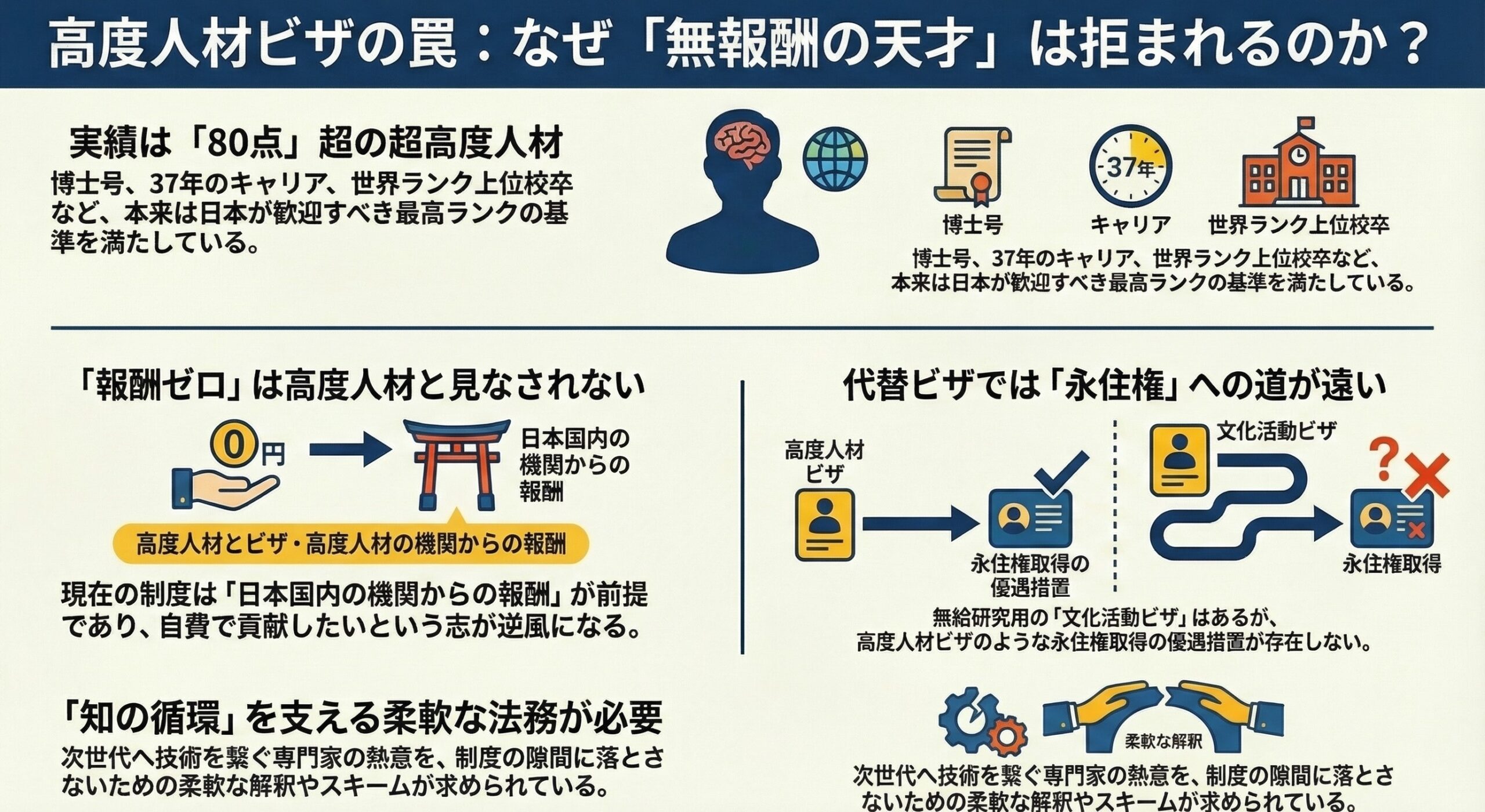
Barrier for "very high-skilled personnel" exceeding 80 points
Japan's immigration system has a "Highly Specialized Visa" that gives preferential treatment to the top tier of academic research and business. A point system is used to award privileges such as the ability to apply for a speedy application for a permanent residence permit if the score exceeds 70 (or 80) points.
D. (30 points), 10 years of work experience (20 points), research experience (20 points or more), and graduation from a world-ranked university (10 points). These are the kind of people that Japan should welcome with open arms, saying, "We would love to have you here.
Is "unpaid" not a highly qualified person?
However, a major practical hurdle stands in the way here. That is the requirement for compensation.
The advanced professional visa is, in principle, an extension of the so-called "work visa," which is based on the premise of receiving a certain amount of "remuneration" from an organization in Japan. Even if, like the consultant, you have a noble aspiration (volunteer spirit) to "conduct research with your own funds and contribute to Japan," if you receive zero remuneration, it is very difficult to fit you into this visa category under the current interpretation.
Despite the fact that people with such knowledge wish to make a contribution while considering permanent residence in Japan, the framework of the system prevents them from doing so with enthusiasm. Here, we can see the issue of "rigidity" that the modern immigration system faces.
Cultural Activities Visa" as an alternative
If you have difficulty being accepted as a "highly qualified professional," there is an option for academic, unpaid research called a "Cultural Activities Visa. This entitles the holder to study Japanese culture and conduct unpaid professional research.
However, this visa does not have the same preferential treatment for permanent residence as the "Highly Specialized" visa. For him, who intends to settle down in Japan as the culmination of his life, this difference is not small.
As an administrative scrivener, I wish from Kyoto
A genuine desire to "connect valuable things to the next generation" that transcends national borders. The same underlying desire will be the same in the case of this professor. Passing on cutting-edge power control technology to young Japanese researchers, and envisioning the future of grid modeling together. This "knowledge cycle" should bring immeasurable benefits to Japan.
The role of an administrative scrivener is not simply to prepare documents. We believe that it is to propose the most appropriate legal schemes to prevent these aspirants from falling through the cracks of the system, and sometimes to create a stir in the way the system works.
To bring the 70-year-old's challenge to fruition on Japanese soil. I am beginning to prepare for the greatest possible proof of the illustrious career he has had and the deep respect he has for Japan.
 日本語
日本語  English
  简体中文
简体中文  Français
  Español
  한국어
한국어  Tiếng Việt