
Don't apply too easily! Hopelessness After Two Years" and New Standards Lurk in Kyoto Startup Visa
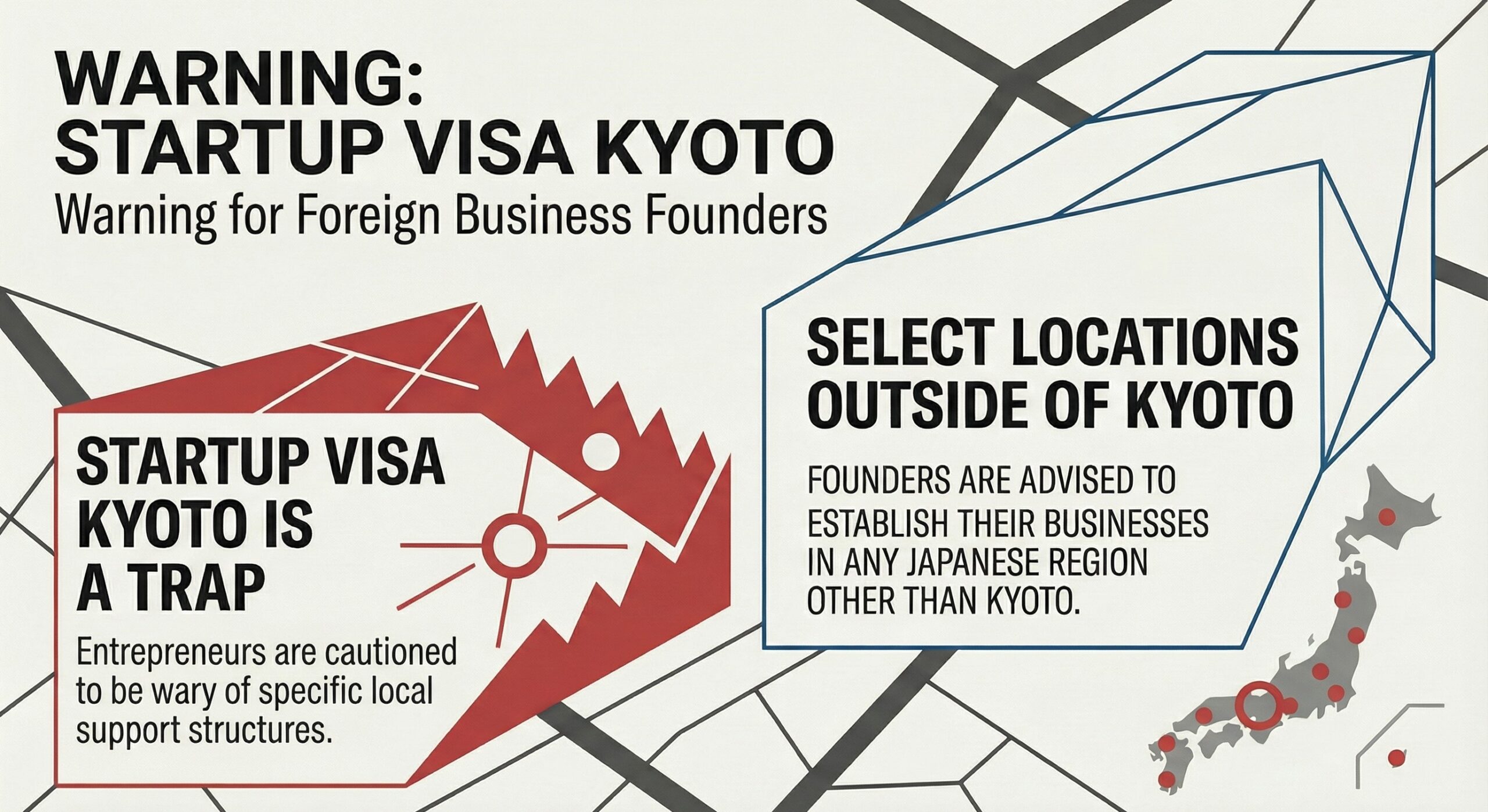
1. Dramatic shrinkage of the "Management/Administration" visa: 30 million yen and the N2 barrier
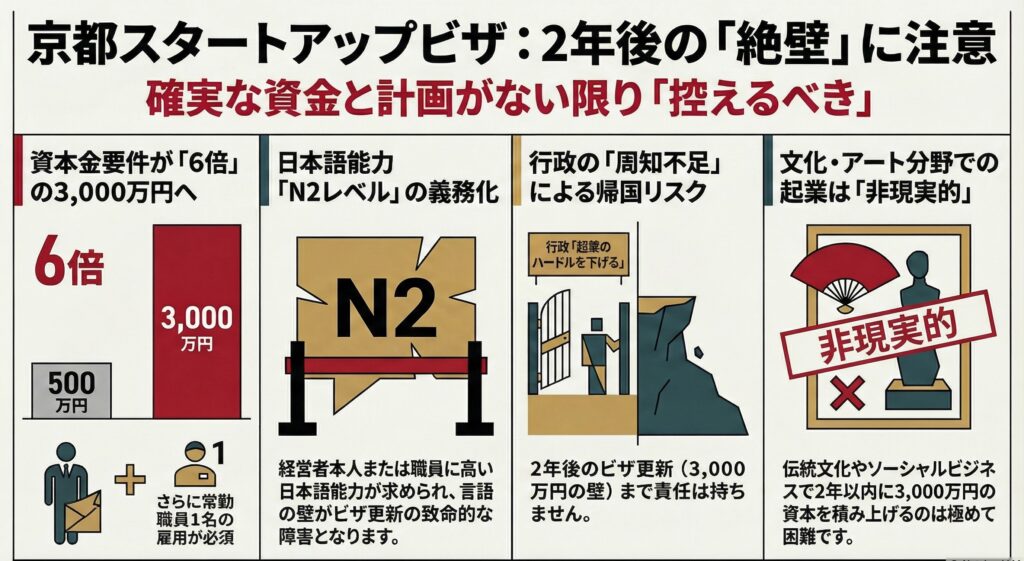
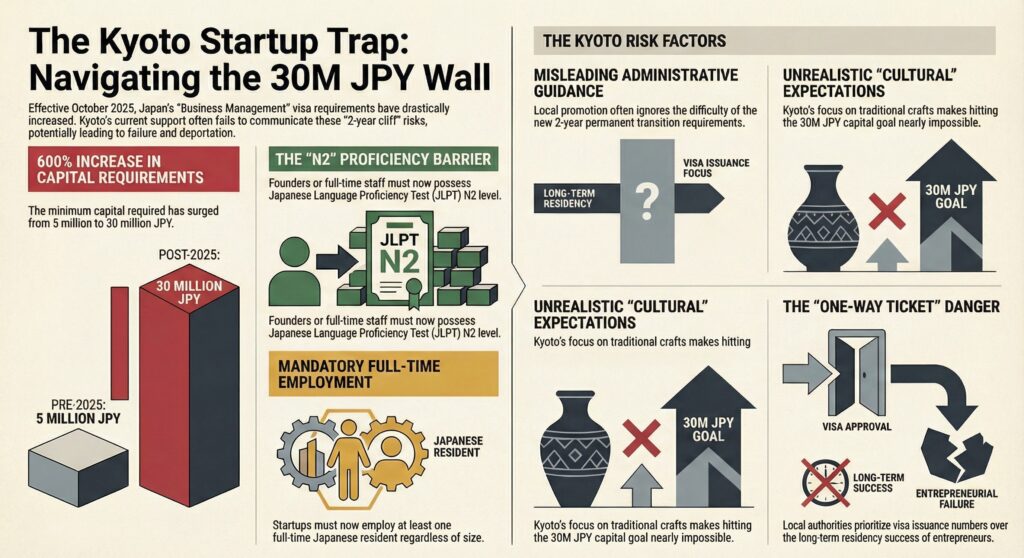
The revised ministerial ordinance, which went into effect on October 16, 2025, significantly raised the criteria for granting the "Management and Administration" visa. The stricter requirements for this visa, which is the final goal of the start-up visa (maximum of 2 years), means a "2-year precipice" for entrepreneurs.
- Dramatic increase in capital: The amount has been raised six-fold from the previous "5 million yen or more" to "30 million yen or more" at once.
- Obligation to employ full-time staff: In addition to capital stock,Employment of one or more full-time employees (Japanese, etc.)is now mandatory.
- Making Japanese Language Proficiency a Requirement: The manager himself/herself or a full-time staff member,JLPT N2 or equivalent or higherThe applicant must have the ability to
- Confirmation of business plan by expertsThe hurdles for screening have been further raised by requiring the submission of a business plan evaluation document by a certified public accountant or a small and medium-sized enterprise diagnostician.
2. Problems with the actual support situation in Kyoto Prefecture: lack of information and irresponsible inducement
For information on start-up visas provided by Kyoto Prefecture (Kyoto Overseas Business Center, etc.),Lack of critical information for the future of entrepreneurs, according to the report.There are
- Lack of awareness of new requirements: If the government's public relations maintains the old tone of "lowering the hurdle for starting a business" after the October 2025 revision, it may lure entrepreneurs who cannot provide ¥30 million in capital after two years into the despair of "forced return.
- Unrealistic demands on the "culture and art" sector: Kyoto Prefecture encourages entrepreneurship in traditional culture and social business, but it is extremely difficult to accumulate 30 million yen in capital and maintain full-time employment in these fields within just two years.
- Landscape ordinances and other region-specific restrictionsKyoto City has strict landscape ordinances and district plans, and it is more costly and time-consuming to secure a business site than in other cities.
3. Why you should "refrain" from applying for a start-up visa in Kyoto
Applying for a start-up visa easily under the current Kyoto Prefecture support system is a major risk to your career.
- The risk of a "one-way ticket.": When your start-up visa expires, if you cannot meet the new criteria of 30 million yen, employment, and N2, you will not be able to continue your business in Japan. The government will accept the application, but will not be responsible for the subsequent visa renewal.
- Sacrifice of performance building: Municipalities seek "the number of start-up visas issued" as an achievement, but they do not always provide friendly support regarding the subsequent transition rate to "management and administration" and the retention rate of entrepreneurs.
- Consider more flexible municipalities: Other special zones and municipalities offer their own subsidies and more practical consulting services. It is dangerous to be attracted only by the "brand power" of Kyoto and proceed without facing the harsh reality.
Conclusion: Rigorous simulation at your own risk.
Starting a business in Kyoto is attractive, but as far as the current legal changes and government response,We do not recommend applying for a start-up visa in Kyoto unless you have sufficient financial resources (30 million yen or more), a solid employment plan, and high Japanese language skills from the start.
If your plan is not feasible, you need to have the courage to stop applying for the visa.
References:.
- [1] Immigration and Residence Management Agency "Revision of Permission Criteria for Management and Administration" (effective October 16, 2025)
- [2] Public Notice on the Promotion of Entrepreneurial Activities by Foreign Nationals (last revised October 16, 2025)
- [3] Comparative Table of Revised Start-up Visa Requirements (effective October 16, 2025)
 日本語
日本語  English
  简体中文
简体中文  Français
  Español
  Tiếng Việt
  한국어
한국어