A Guide to "Career Change" for Specified Technical Foreigners: Three Ironclad Rules for a Smooth Transition
Job change is an unavoidable theme in the employment of foreign nationals with specific skills. Supporting foreigners who are seeking career advancement or improved conditions to follow the appropriate procedures will not only prevent problems, but will also help build confidence in the Japanese labor market as a whole.
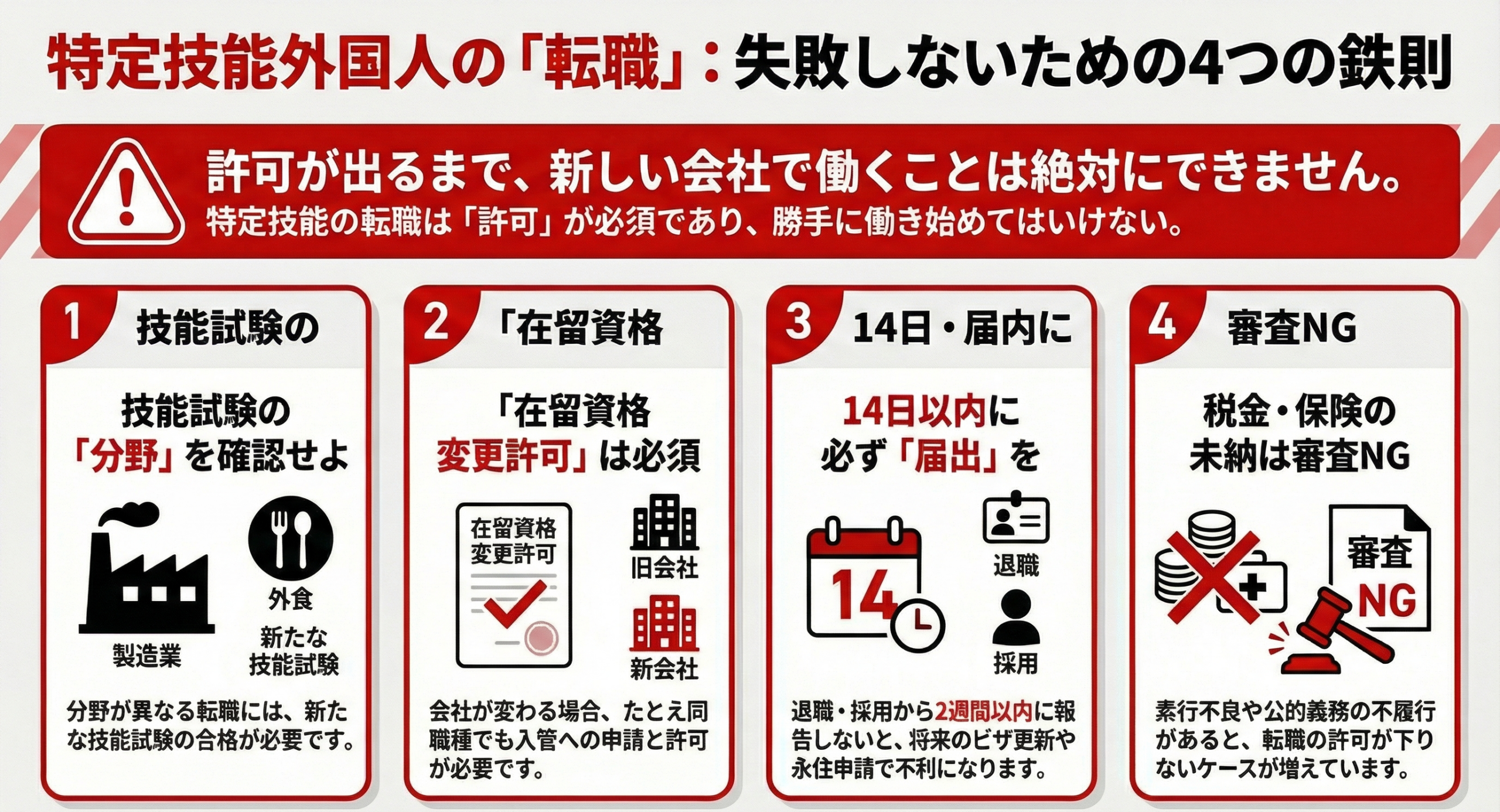
1. the "field" barrier: same category or other
The most important question when changing jobs for a specific skill is whether the current status of residence is valid at the new company.
- Career change within the same field: Since the skills test is common, it can be transferred directly (e.g., from one food service business to another food service chain).
- Change to a different field: You must re-pass the "skills evaluation test" applicable to the field in which you are changing jobs (e.g., from food and beverage manufacturing to food service).
In both cases, the applicant is considered to have already met the requirements of the Japanese Language Proficiency Test (e.g., JLPT N4 or higher), but only proof of proficiency will be rigorously checked.
2. "Application for permission for change of status of residence" is required
The most common misconception is the assumption that since it is the same "specified skill," one can start working with only a notification.
The status of residence for specified skills is,Permitted on the basis of a contract with a "specific institution (company)"The company is not allowed to change your status of residence. Therefore, if you change companies, even if you have the same job title, you cannot work on site until you apply for a "permission of change of status of residence" to the competent immigration/residency office and obtain permission at the new company.
Caution: In principle, it is also prohibited to allow a person to work part-time during the "gap period" between quitting a previous job and receiving the next permit, without obtaining a work permit for activities other than those permitted under the status of residence. Companies must be very careful to avoid being accused of encouraging illegal employment.
3. don't forget to "notify" within 2 weeks
When a job change (resignation and employment with a new company) occurs, a "Notification of Transfer" is imposed on both the individual and the company.
- Deadline: From the date the event occursWithin 14 days
- Where to submit: Immigration and Immigration Bureau (online reporting is also available)
Failure to submit this notification may have an adverse effect on future applications for permanent residence or renewal of the period of stay.
Checklist for the Job Change Process
| step | Confirmation |
| Step 1: At the time of offer | Does the job description of the new company match the skill tests that the individual has passed? |
| Step 2: After retirement | Did you promptly collect the "rishokuhyo" or "gensen choshuhyo" from the previous company? |
| Step 3: Application | Have you applied for "permission for change of status of residence" to the Immigration Bureau? |
| Step 4: Start of employment | Have you received your new resident card? |
Advice from an Administrative Lawyer
The procedures for changing jobs for specified skills require more documents to be submitted than general work visas (technical, humanities, international services, etc.), and the system of the receiving company (formulation of support plans, etc.) is also subject to rigorous examination.
In particular, "poor conduct" and "noncompliance with official obligations (nonpayment of taxes and insurance)" are increasingly being disallowed at the time of job change. Routine labor management and an accurate understanding of the system are the keys to retaining excellent personnel and smooth job changes.
 日本語
日本語  English
  简体中文
简体中文  Français
  Español
  한국어
한국어  Tiếng Việt