I will reply to you within 24 hours/.
Must-see for foreigners who want to work in Kyoto's inbound industry! 2 main visas and conditions for acceptance.
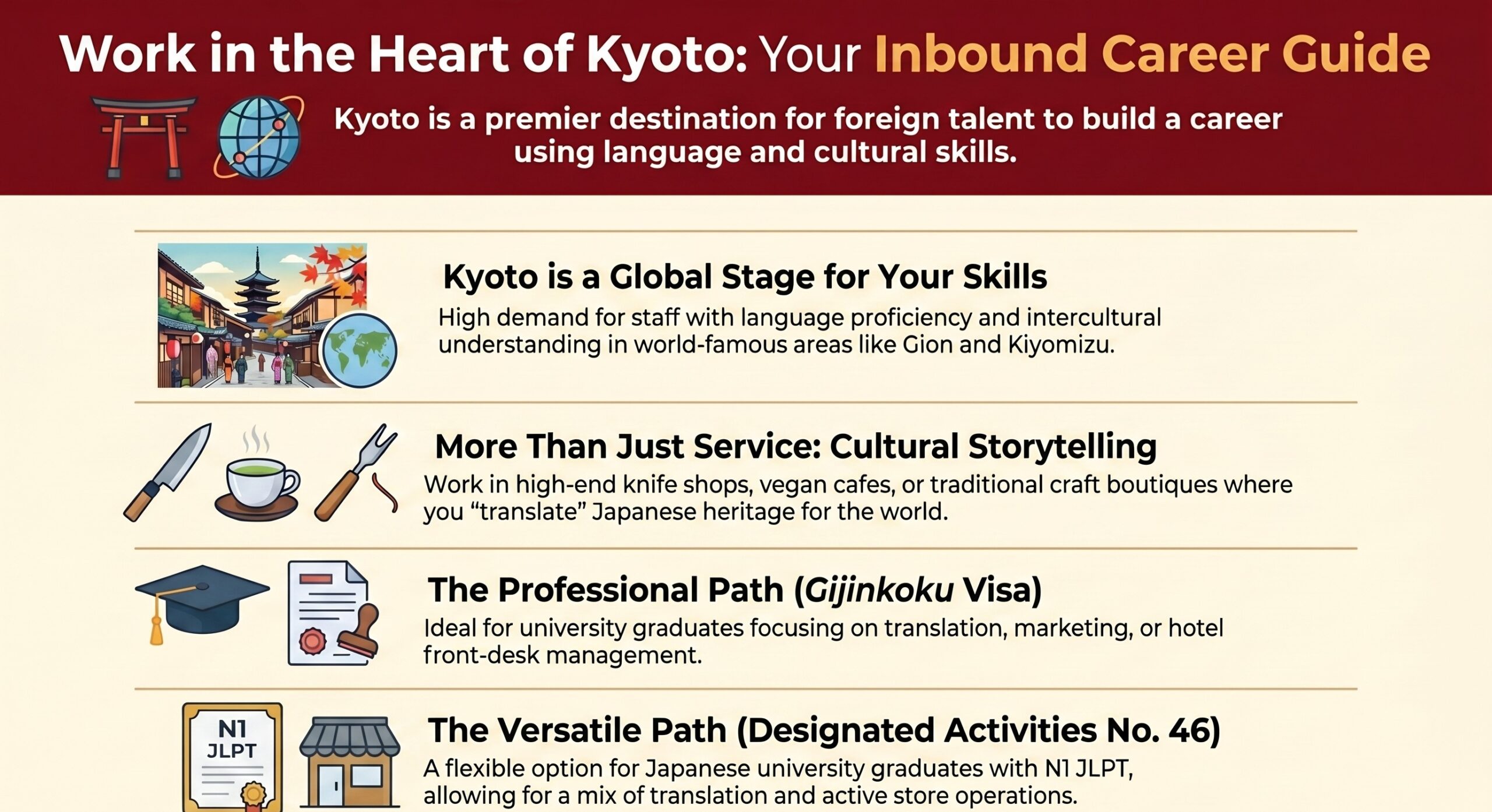
Kyoto is a world-class tourist city and an area with a very high demand for foreign staff with language skills and cross-cultural understanding. However, the visa (status of residence) to obtain to work in Japan depends entirely on "what kind of work" and "what your educational background".
Regardig two main visas, particularly central to the inbound field,the following is a clear explanation of the specific conditions.
TOC
1. High street visa to work at the front desk or in planning
Technical, Humanities and International Services" (commonly known as "Gijinkoku")
This visa is for "jobs that primarily involve desk work or specialized language skills," such as hotel reception, tour planning at a travel agency, or marketing.
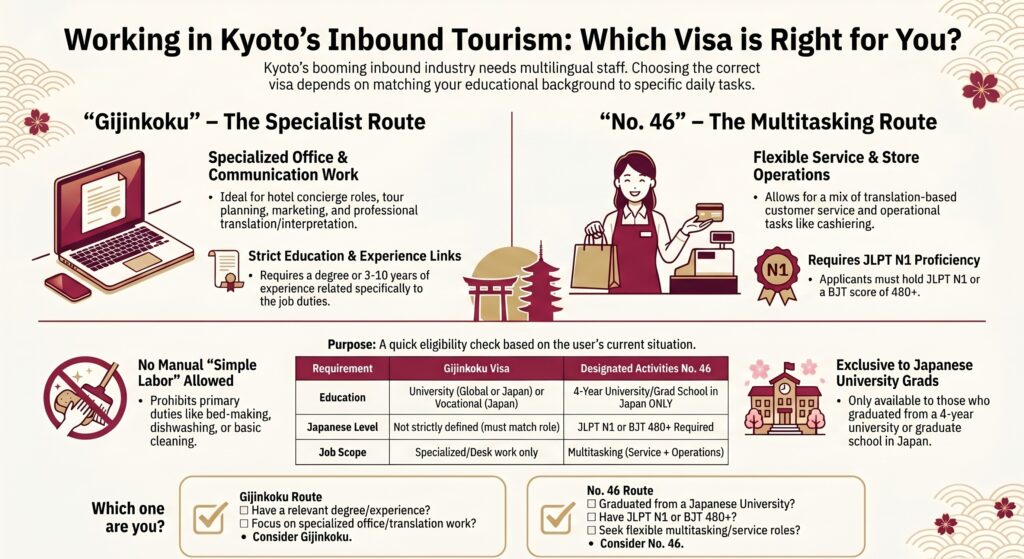
| Item | Specific conditions |
| Main business | Hotel front desk support and concierge using foreign languages, planning of sightseeing plans, translation and interpretation. |
| Education and Work Experience Requirements | (1) Graduation from a Japanese or foreign university or graduate school, or graduation from a Japanese vocational school. (ii) If proven by work history, at least 3 to 10 years of work experience in the job for which he/she is responsible. |
| Cautions (pitfalls) | The "relevance of what you have studied to your job" will be strictly looked at. For example, a person who studied "tourism" or "languages" at university is allowed to work at the front desk, but a person who studied "IT (programming)" is more likely to be denied permission to work only at the front desk of a hotel. |
⚠️ Things to note
This visa does not allow for "simple on-site work (practical work)" such as making beds, cleaning guest rooms, or washing dishes in a restaurant as the main activity.
(2) Versatile visa to handle a wide range of tasks from customer service to store management
"Specific Activity 46."
This is a relatively new visa designed for "foreign students who have graduated from a Japanese university and have a high level of Japanese language ability. This visa allows you to work at inbound stores (duty-free stores, souvenir stores, high-end boutiques, etc.) and hotels in Kyoto as an interpreter while also performing multiple store duties.
| Item | Specific conditions |
| Main business | Tax free procedures and explanation of products in foreign languages at stores for inbound customers, front desk work at hotels with interpretation, and customer service at restaurants. |
| Academic Background Requirements | Must have graduated from a four-year university or graduate school in Japan. *Overseas university graduates and, as a general rule, graduates of general technical schools (excluding advanced degrees, etc.) are not eligible. |
| Language Requirements | N1" of the Japanese Language Proficiency Test (JLPT)or have a score of "480 or above" on the BJT Business Japanese Proficiency Test. |
| Employment Rules | Part-time or temporary employees are not acceptable. Must be a full-time permanent or contract (full-time) employee. |
💡Here is the point!
Various on-site practical tasks such as cashiering, displaying merchandise, and assisting other staff, which are prohibited under the first "Gijinkoku" visa,The condition that "communication in a foreign language (interpretation and customer service) as the main work" is permitted in conjunction with the work.
Checklist
- If you have graduated from a 4-year university in Japan and your Japanese is at N1 level...👉 "Specific Activity 46" is recommended. You can aim for a wide range of careers from inbound customer service in souvenir stores to store management.
- If you are a graduate of a foreign university or a Japanese vocational school...👉 Aim for "technical, humanities and international work". A shortcut is to look for a front desk job at a hotel or an office job at a travel agency, where you can directly apply your major at school (language, tourism, etc.).
- If you don't meet either education or language requirement but want to work in the field...👉 Another route is to pass the proficiency test for the accommodation industry and the Japanese language test (N4 or higher) to obtain a visa called "Specified Technical Skills No. 1".
Specific examples of inbound sites
Typical examples of inbound tourism in Kyoto are the long-established green tea sweets shop around Kiyomizu-zaka, the "Japanese high-end kitchen knife specialty store" that is booming among foreign tourists in the Gion area, and duty-free stores selling high-end whiskey.
In these stores, foreign staff with high language skills are working on the front lines, as they are required not only to pack products in bags, but also to "communicate" traditions and particulars in foreign languages.
1. Vegan cafes popular among foreigners
The Kiyomizu-dera area and Higashiyama-ku area are dotted with progressive cafes that have renovated historic buildings and target vegan, vegetarian, and gluten-free tourists, mainly from the Western world.
Here, the main task is not only to take orders and deliver food, but also to communicate (interpretation and customer service) with customers from overseas, carefully explaining in foreign languages the ingredients and particulars, such as "No eggs or dairy products are used in these sweets" and "We use organic green tea produced in Kyoto".
2. Stores specializing in kitchen knives and traditional crafts (Kiyomizu/Gion area)
Today, "kitchen knives made by Japanese craftsmen" and "traditional handicrafts" are enjoying a huge boom, especially among wealthy people in Europe and the United States. Since these products have a very high price per customer and require sophisticated product explanations, they have become the main battleground for foreign staff with high language skills.
3. Drugstores and souvenir mass merchandisers (around Gion-Shijo and Shijo-Kawaramachi)
This is a site that handles large quantities of pharmaceuticals, cosmetics, and confectionery, which are staples of the inbound market. This is where "overwhelming speed of customer service and multilingual duty-free procedures" are required.
4. Duty-free store specializing in high-end whiskey and liquor (Gion area)
In the area around Yamato-oji Dori and Shijo Dori in Gion, there are an increasing number of duty-free sake specialty stores that mainly sell Japanese whiskey (Yamazaki, Hibiki, etc.) and high-end Japanese sake, which are very popular among foreign visitors to Japan.
5. Japanese sweets, Kyoto specialties, cosmetic stores (Kiyomizu-zaka and Sanneizaka area)
The approach to Kiyomizu-dera Temple (Kiyomizu-zaka, Gojo-zaka, and Sanneizaka) is lined with many famous Japanese confectionery stores and brands from Kyoto, many of which offer tax-free services.
 日本語
日本語  English
  简体中文
简体中文  Français
  Español
  Tiếng Việt
  한국어
한국어