I will reply to you within 24 hours/.
Proposal: Don't Let Kyoto's "Multicultural Conviviality" End Up as a Transient Slogan
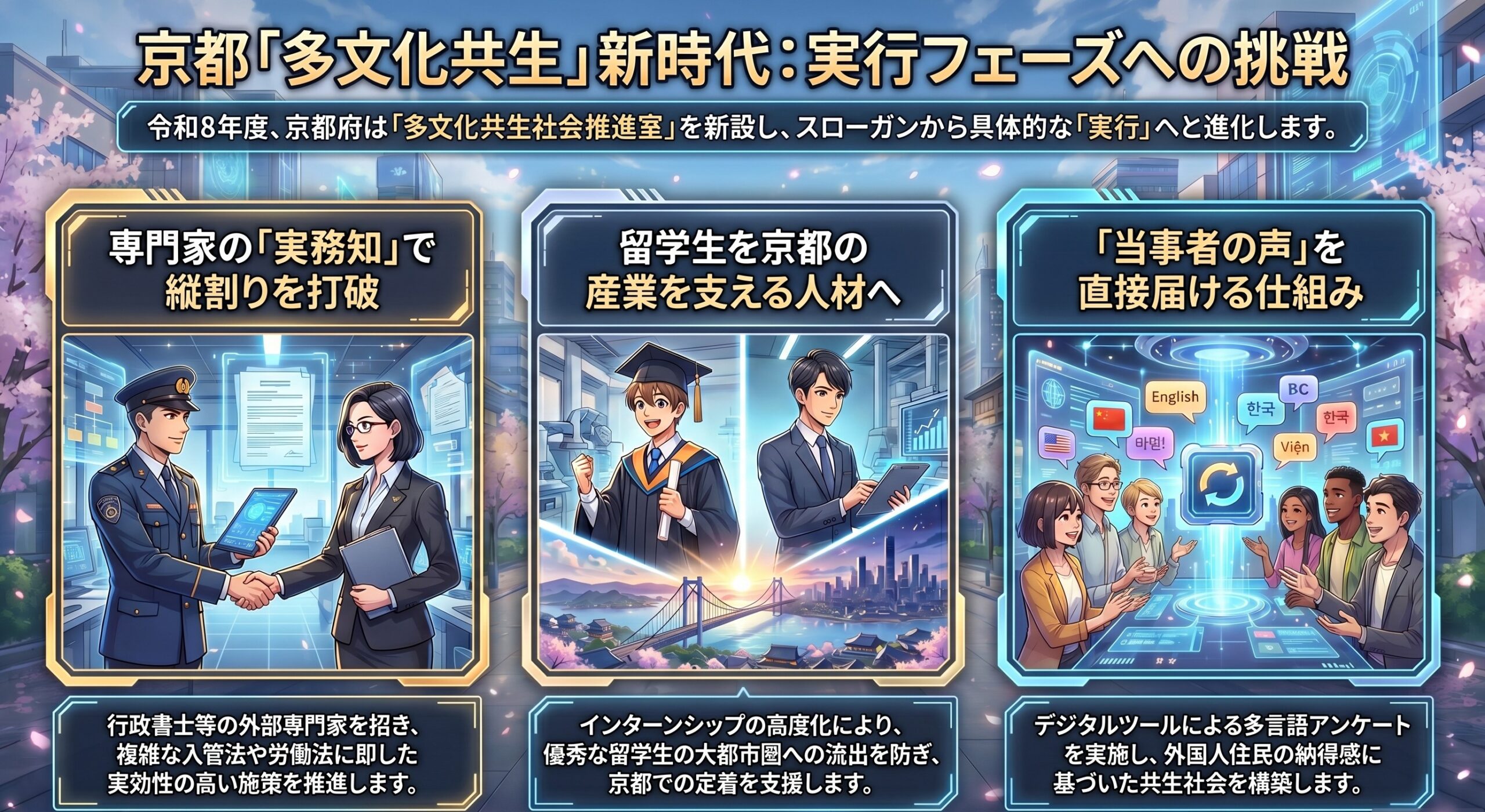
In FY2026, Kyoto Prefecture's "Multicultural Conviviality" program has moved from the idealistic phase to the "implementation" phase.
As part of the recent reorganization, the "Office for the Promotion of a Multicultural Society" will be newly established in the Department of Policy and Environment. This is an epoch-making step away from the traditional stove-piped approach and will establish a cross-departmental "command post". In addition, highly concrete measures are lined up, such as the establishment of the "Committee for the Promotion of a Multicultural Society (tentative name)," which will unite industry, academia, public, and labor, and support for the retention of foreign students.
To ensure that this new challenge is not merely a reorganization, but an effective "Kyoto Model" from the viewpoint of experts in the fieldThree Key Tacticsrecommendations.
TOC
1. breaking down vertical divisions and strengthening compliance by injecting "practical knowledge
To ensure that the comprehensive coordination function of the government is not limited to paperwork, organic collaboration with outside experts who know what is happening on the ground is essential.
- Tactics: Invited experts such as administrative scriveners who are at the forefront of employing foreigners as external advisors.
- Effect: Real-time updates of increasingly complex immigration and labor laws and regulations are reflected in policies. Practical guidelines can be formulated to prevent mismatches between companies, foreign nationals, and the government (e.g., incompatibility of status of residence).
2. "Exit Strategies" for Supporting International Students -- Human Resource Retention to Support Kyoto's Industries
Beyond "exchange," we need to look beyond "exchange" to ensure that Kyoto's key industries (traditional crafts, manufacturing, tourism, etc.) are firmly established.
- Tactics: Collaborating with universities, companies, and specialized consultants to promote the upgrading of internships to "credit" and "reward" type.
- Effect: Directly communicate the attractiveness of small and medium-sized enterprises and stop the outflow of talented foreign students to metropolitan areas, thereby securing the bearers of the local economy.
Preventing committee meetings from becoming a mere shadow of their former selves through the "perspective of the parties concerned
A mechanism is needed to ensure that the promotion committee is not merely a debriefing session, but an effective PDCA cycle.
- Tactics: In addition to NPOs and practitioners who represent the voice of the field, direct questionnaires (in multiple languages) were conducted with foreign residents using digital tools.
- Effect: Reflecting "the conviction of the parties concerned" in our measures. Prevent problems in local communities and build a truly symbiotic society.
My thoughts: As an alumnus of Kyoto Prefecture and a legal professional
In the past, as an employee of the Kyoto Prefectural Government, I was busy with international affairs and stationed in Singapore. It is because of my experience from those days that I deeply support and have high expectations for the prefecture's challenge this time.
Currently, as an "administrative scrivener specializing in international affairs," I face the earnest voices of foreign residents and the companies that support them on a daily basis. There is "justice" and "circumstances" of the government in the administration and of the field in the field. In order to connect these two and make policies take root in the community,A bridge to understanding "both languagesis essential.
Kyoto must continue to be "a city open to the world, chosen by highly skilled foreign human resources". As an alumnus and a specialist, I am prepared to accompany Kyoto in this new stage.
 日本語
日本語  English
  简体中文
简体中文  Français
  Español
  Tiếng Việt
  한국어
한국어