I will reply to you within 24 hours/.
Preventing "mental SOS" in international students: a multi-layered approach to support cross-cultural adaptation
In recent years, an increasing number of international students have entered Japanese schools with great aspirations. At the same time, however, there have been many cases of mental health problems due to a sense of isolation caused by language barriers and the inability to fit in with the unique group culture.
Myself, in fact,While working for the Kyoto Prefectural Government, she was in charge of counseling foreign youths (language teaching assistants, etc.) coming to Japan under the JET program.I was there. What I saw there were young men and women who had arrived at their new posts with great expectations, only to find their bodies and minds unknowingly being worn down in the peculiar society of Japanese schools.
Teaching in the educational field and consulting for foreign youth in Japan: In addition to teaching cross-cultural understanding at the Kyoto Prefectural Board of Education, he also worked at the High School Education Division and International Affairs Division, consulting with foreign youths who came to Japan on the JET program to resolve problems in their work environment. I cultivated the ability to adjust to resolve problems unique to foreign nationals and differences in perception with the receiving side.
Representative Introduction
https://matsutani-gyosei.com/alex_visa/profile/
We rethink the stresses they face and the approaches we should take to address them.
1. "Steps of adaptation" and the nature of invisible stress
Many of the ailments that foreign students and foreign youth suffer from are not due to their own qualities, but rather to a psychological process called "culture shock.
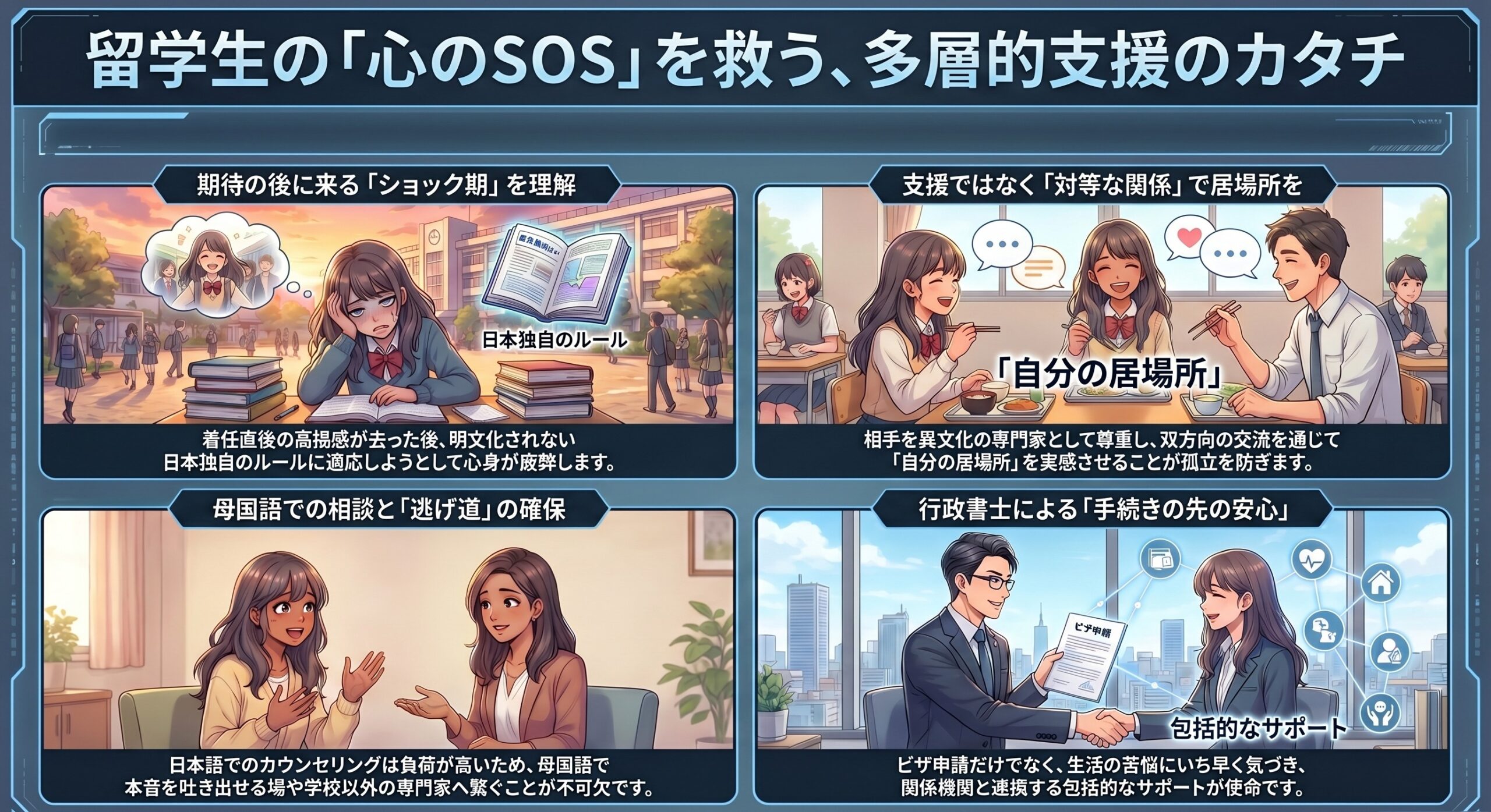
What I have witnessed in the JET Programme is the deep "shock period" that comes after the initial excitement of arriving in Japan. The "A-Un" breathing style unique to Japanese staff offices and the detailed rules that are not clearly stated. Many of the young men were so exhausted that they could not move after returning home because they had to sharpen their nerves to adapt to the new environment. It is extremely dangerous to dismiss this stress as "mere selfishness" or "pampering.
2. changing the "quality" of communication: ensuring psychological safety
In Japanese schools, students are sometimes given "special treatment" with good intentions or, conversely, forced to be "the same as the Japanese".
- A Wall Called "Isolation": The Over-consideration of their surroundings may instead treat them as if they were invisible, deepening their loneliness.
- Two-way exchange:. Support is not only about "helping" them. Respecting them as cross-cultural professionals and making them feel they "belong" in the classroom or workplace by building relationships with them as equals is the greatest cure for preventing isolation.
3. professional support and "escape routes
When the stress of cross-cultural adjustment manifests itself as physical symptoms (insomnia, loss of appetite, chronic fatigue), counseling in Japanese can be an additional burden.
- Utilization of multilingual resources:. It is essential to have a place where people can express their true feelings in their native language.
- Importance of early intervention:. Through counseling, I became convinced that the only way to prevent serious illness is to connect them to "a place outside of school" or "a third-party specialist" at an early stage, without overlooking small signs.
4. as an administrative scrivener and as a person with experience
Currently, as an administrative scrivener, I consult with foreign students on visa renewal and other matters, and I often feel the "anguish of life in Japan" that lies behind the procedures.
What administrative scriveners can do is not merely to prepare documents. I will use my experience at the Kyoto Prefectural Government to quickly notice any changes in their mental health and, if necessary, collaborate with schools and related organizations. I believe it is my mission as a specialist to provide such "peace of mind beyond the procedures.
4. Conclusion
The "SOS" of an international student does not always emanate in words. We, the ones who accept them, must understand the mechanisms of cross-cultural adaptation correctly and support the process with a tolerant eye.
Based on the experience of working with the youth of the JET program, we will continue to do our best to support the future of international students studying in Japan from both legal and psychological perspectives.
 日本語
日本語  English