I will reply to you within 24 hours/.
"The 5-Year Hurdle" in Regular Interviews for Specified Skilled Worker (1) in the Food Service Industry: A Roadmap to Transitioning to (2) and What Companies Should Do Now
Do I have to return to my country after the 5-year period ends?
During our quarterly consultations with foreign workers holding Specified Skills Visa 1 for the food service industry, mixed with feedback on their work and concerns about daily life, aren't the more serious and talented individuals increasingly voicing anxieties about their future?
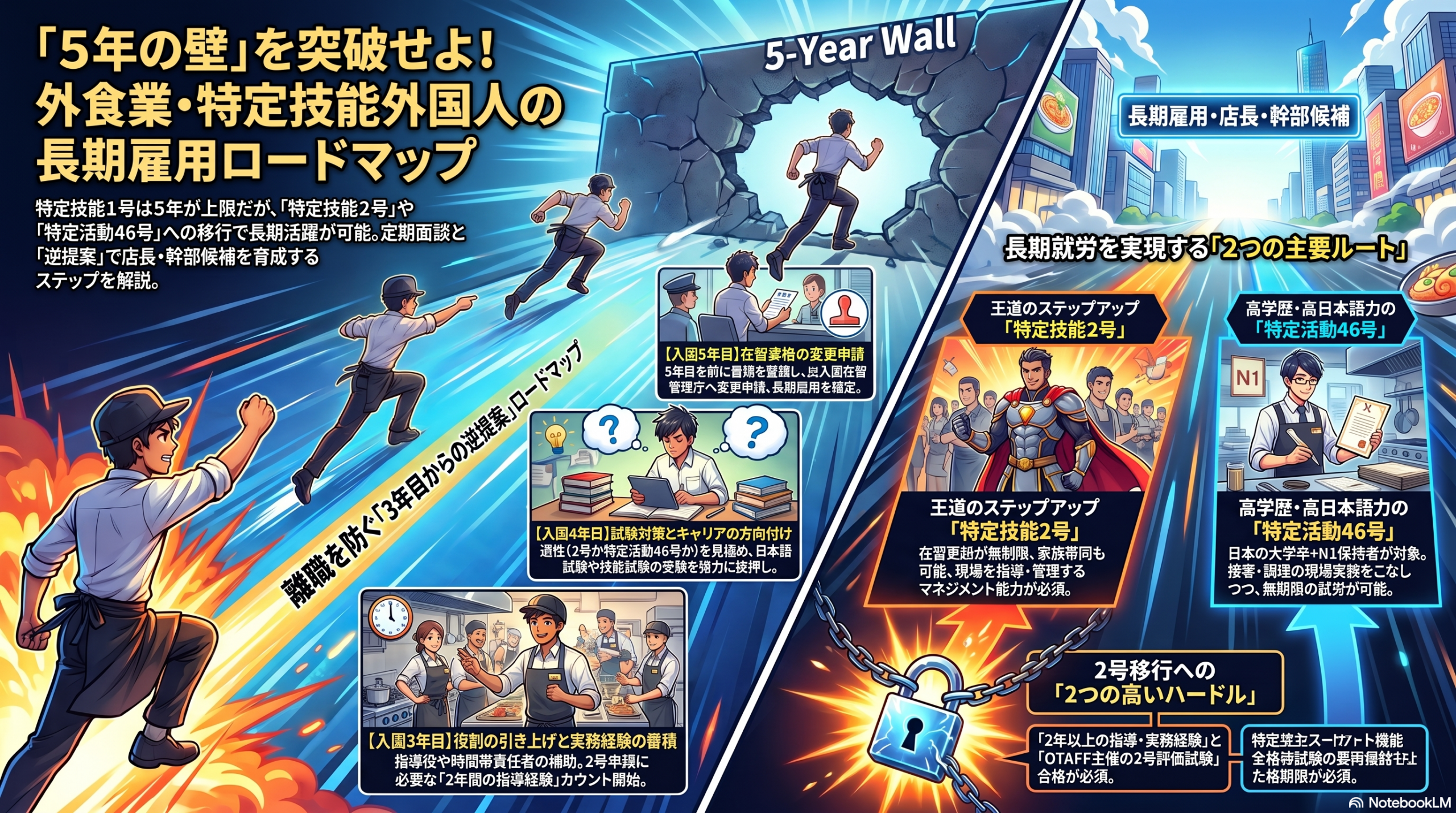
The maximum period of stay for Specified Skilled Worker (SSW) 1 is five years in total. Previously, many had to give up thinking "five years is the limit." However, there are now several pathways available for long-term employment and career advancement in Japan. To transform regular consultations from mere obligatory interviews into opportunities for jointly planning career paths, we will organize the options we should present and the necessary preparations.
TOC
1. The mainstream that remains as the core of the industry: The food service industry "Specified Skilled Worker 2"
In the food service industry, the Specified Skilled Worker (SSW) visa category 2 is a status of residence that represents a further step up from the "skilled labor" of category 1, requiring management skills to "assist with store operations while guiding and managing multiple workers."
If we can transition to version 2, the following dramatic benefits will materialize:
- The maximum period of stay will be abolished(Enables long-term career development)
- Family members (spouse and children) may accompany you if the requirements are met.
Hurdles for transitioning to Version 2
However, not just anyone can become one if they wish. Based on standards set by organizations such as OTAFF (Overseas Food Industry Skills Assessment Organization), the following two requirements must be met:
◆Passing the exam
Japanese Language Proficiency Test (N3 or above)
Food Service Industry Specified Skilled Worker Class 2 Examination (Organized by OTAFF)CBT exam for subjects and practical skills, given only in Japanese (without furigana).
Food Service Industry Specified Skilled Worker Class 2 Examination (Organized by OTAFF)
The pass rate for the “Specific Skilled Worker Category 2 Skills Assessment Test (organized by OTAFF)” in the foodservice industry has generally ranged from around 45% to 60% in previous test sessions.
Learning texthttps://x.gd/7Uihi
2 will be changed to "qualification to permanently reside in Japan and be established as core human resources in companies (executives, store managers, etc.)".
The main changes that will become possible are the following four points:
The "ceiling of 5 years" for the period of stay will be removed
- Option 1: In totalUp to 5 yearsI can only stay in Japan until.
- For number 2: For extension of period of stayThere is no upper limit.(You can continue to work in Japan semi-permanently by clearing the 1-year, 3-year, or 5-year renewals.)
- Benefits: From the company's perspective, they no longer need to let go of talented employees they've nurtured over many years after just five, enabling long-term store management and career path development.
2. Become able to invite family (spouse/children) to Japan
- Option 1: As a general rule, family accompaniment is not permitted.
- For number 2: If you meet the requirements (such as financial ability), you can bring your spouse and children to Japan and live together (family accompaniment).
- Benefits: This will be a decisive factor in connecting foreigners to mental stability, freeing them from a quasi-single-person assignment, and encouraging them to work in Japan for the long term.
3. Be able to meet the application requirements for permanent residency (number of years of residence)
- Option 1: The period of stay in Japan with visa #1 will be counted towards the "period of stay with work eligibility (5 years or more in principle)" required for the permanent residency application.Not included..
- For number 2: From the moment you transfer to No. 2, the duration of your staywill be counted as work experience for the permanent residency application.
- Benefits: This is the most motivating point for talented foreigners who wish to permanently reside in Japan in the future.
4. Exclusion from "Mandatory Support" by registered support organizations (cost reduction)
- Option 1: Companies are obligated to provide "10 items of support," including lifestyle orientation, regular interviews, and transportation, and in most cases, they pay a monthly委託 (outsourcing) fee to a registered support organization.
- For number 2: TheseMandatory support is completely unnecessary.will be.
- Benefits: For companies, the monthly outsourced cost (support fee) becomes zero, and it is purely employment management (equivalent to general Japanese employees), significantly lowering acceptance costs.
2. [N1/N2 Holders] Roadmap for Highly Proficient Japanese Speakers
If the staff member you are interviewing has alreadyJapanese Language Proficiency Test N1 and N2If you have obtained [this], the future that companies can offer will expand further. In particular, if you are a holder of N1 or higher, you have already overcome the biggest hurdle of Test 2, which is "specialized Japanese without furigana," so the certainty of transitioning to Test 2 will increase significantly.
Furthermore, if the staff member has an academic background (university/vocational school graduate), switching to one of the following two status of residence, which go beyond the scope of Specified Skills, becomes a realistic option.
[New Standard] "Specific Activity No. 46" Allows for On-Site Work
If you have graduated from a Japanese university or graduate school (obtained a degree) and possess Japanese Language Proficiency Test N1 (or BJT Business Japanese Proficiency Test 480 points or higher), changing your status of residence to "Designated Activities 46" (Graduates of Japanese Universities) is highly beneficial.
- Biggest advantage: Ability to perform on-site operations (customer service/cooking)In general, with a white-collar visa (e.g., "Gijinkoku"), simple labor in a store or site-based work is generally not permitted. However, with "Special Activity Visa No. 46," while incorporating translation and interpretation elements utilizing high Japanese language proficiency and customer service duties,To perform various hands-on tasks in stores, such as customer service and cooking.is publicly recognized.
- Interview approach:"If you have graduated from a Japanese university and passed N1, we can switch you to the 'Designated Activities No. 46' visa, which has no 5-year limit, and have you lead our team as a future store manager or area manager candidate." This offers a vision of you as a candidate for management within the company.
② [Headquarters/General Employment] "Technology, Humanities, International Services (Gijin-koku)"
This is an option for those who have graduated from a university or vocational school in their home country or Japan and are shifting entirely to specialized, academic office work such as "headquarters marketing," "buyer," "store development," or "multilingual public relations/human resource management," rather than working in a store. High Japanese language proficiency (N1/N2) will make it easier to prove professional expertise in these roles.
Roadmap for "Reverse Proposals" to Be Made by Companies During Regular Meetings
Having excellent staff leave because they think "it'll all be over in 5 years" is a huge loss for the store. Utilizing the timing of regular interviews and presenting concrete steps like the following can lead to a sense of security.
Steps for transitioning to Status 2 and visa renewal (e.g., during the interview in year 3 of Status 1)
1. Elevating a role (position):It's my third year in Japan.
Through interviews, we confirm the applicant's motivation, academic background, and Japanese language proficiency, and gradually assign them management tasks such as "training junior staff" and "assisting with shift supervision" at the store. This marks the start of the "2 years of practical training experience" required for Type 2 visa.
2. Japanese Language/Career Direction Determination:3-4 years after entering the country.
If you meet the requirements of a Japanese university degree and N1 level or above, you should consider preparing to switch to "Designated Activities No. 46" at this stage (adjusting job duties). For the route aiming for No. 2, we encourage applicants to take the exam for N3 level or above.
3. Exam Application and Document Preparation4th to 5th year since entering the country.
For Route 2, register the applicant through the company's My Page and have them take the OTAFF Category 2 exam (CBT format). For the Specified Activities Article 46 route, collect the diploma and Japanese proficiency documents.
4. Application for Change of Residence StatusBefore reaching the 5th year.
Gather the required documents for each route and apply for a change of status at the Immigration Services Agency.
Summary: Regular interviews to foster "future store managers and executives."
The regular interviews for Specified Skills visas are not just for checking if there are any daily troubles.
Especially for staff who have been with the company for over three years, we will take stock of their strengths, such as their "Japanese language proficiency" and "educational background," and aim for "Specified Skills 2.".This is an excellent opportunity for companies to present concrete options like "Specific Activity No. 46."
By showing an attitude that "the company is thinking about their future together," they will have hope for their future in Japan and will contribute even more to the store. Let's turn the five-year hurdle into an opportunity for growth for both the company and the individual.
 日本語
日本語  English
  Italiano
  한국어
한국어  简体中文
简体中文